Planetary genealogy: Milky Way worlds belong to 1 of 2 ‘families,’ scientists find
Scientists have performed a cosmic genealogy on planetary systems in the Milky Way, finding two distinct families that influence the evolution and fate of these systems.
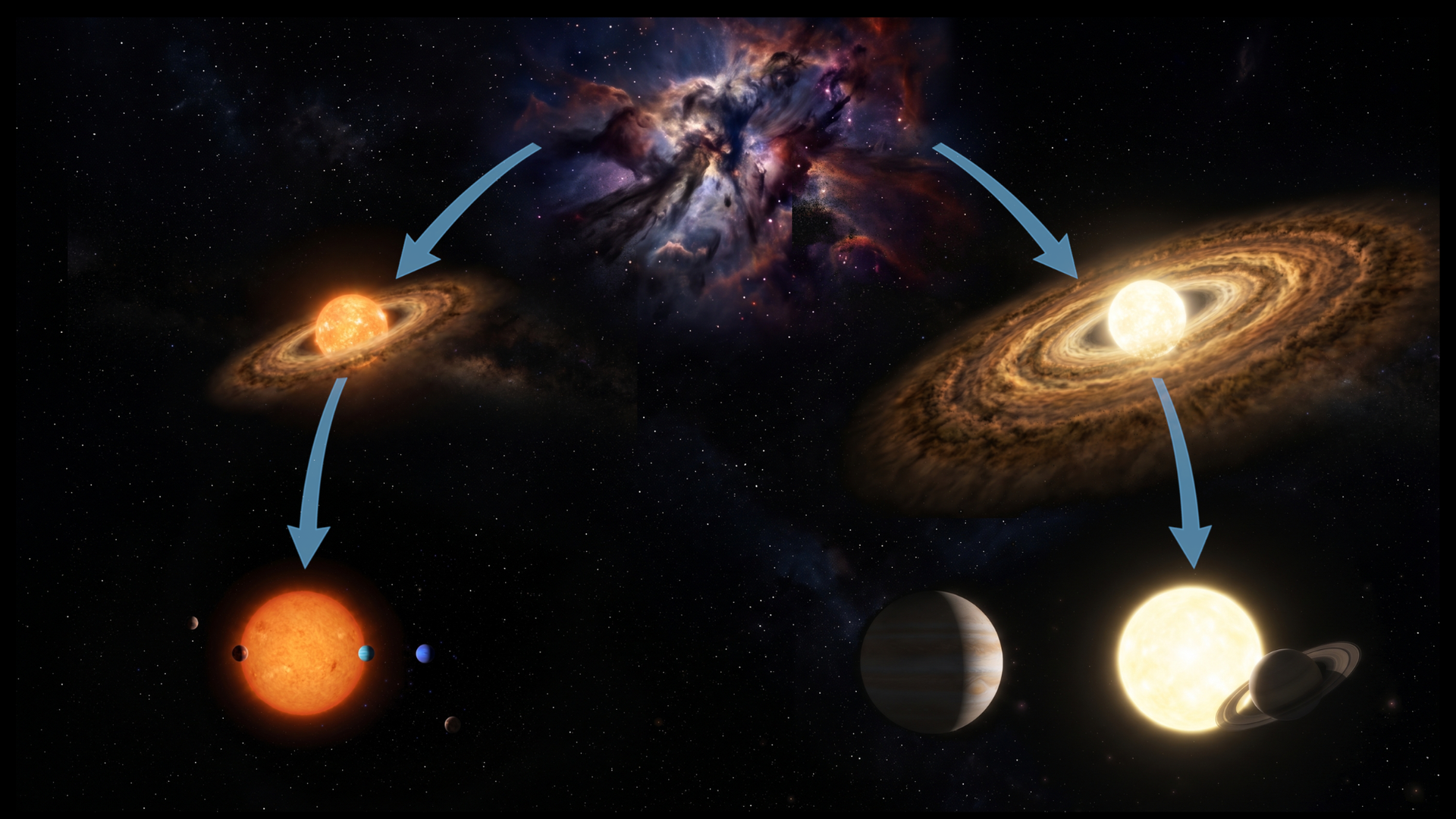
Scientists have discovered that planetary systems in the Milky Way can be categorized into two families, revealing how stars influence the evolution and fate of these systems. Led by researchers at the Italian National Institute for Astrophysics (INAF), the study analyzed 300 well-understood multiplanet systems out of over 1,000 discovered in the Milky Way.
The research clarifies the impact of infant star environments on planetary fates and potentially habitable exoplanets capable of hosting life. The study aimed to answer the fundamental question of what determines the characteristics of planetary systems, whether they are established at birth or sculpted by evolution over time. The researchers found a genetic link between planetary systems and their stars, which determines their fate depending on the star they are born around.
The first family consists of wide, massive systems with planets orbiting more massive stars with lower metal concentrations than our sun. The second family is more compact and lower-mass, with planets having comparable masses and sizes, orbiting stars similar to or less massive than the sun. The differences between the two families are attributed to gravitational instability caused by events like giant collisions and planetary ejections, which are more common in the first family.
The number of these turbulent events experienced by a planetary system can be linked to the variations in the environment in which planets form, which arises due to differences in the properties of the parent star. The research, published in the journal Nature Astronomy, was performed using simulations of planetary system evolution, which began with different conditions, to confirm the findings.
Written by urgent.news from Space.com's reporting — not their text. Machine-written — may contain errors; check the original before relying on it.