KAIPTC Commandant calls for continent-wide strategy to tackle Africa’s maritime security threats
The Commandant of the Kofi Annan International Peacekeeping Training Centre (KAIPTC), Air Vice Marshal David A. Akrong, has called for a continent-wide approach to maritime security, warning that geopolitical tensions, organised crime and shifting global shipping routes pose growing challenges to Africa’s coastal states.
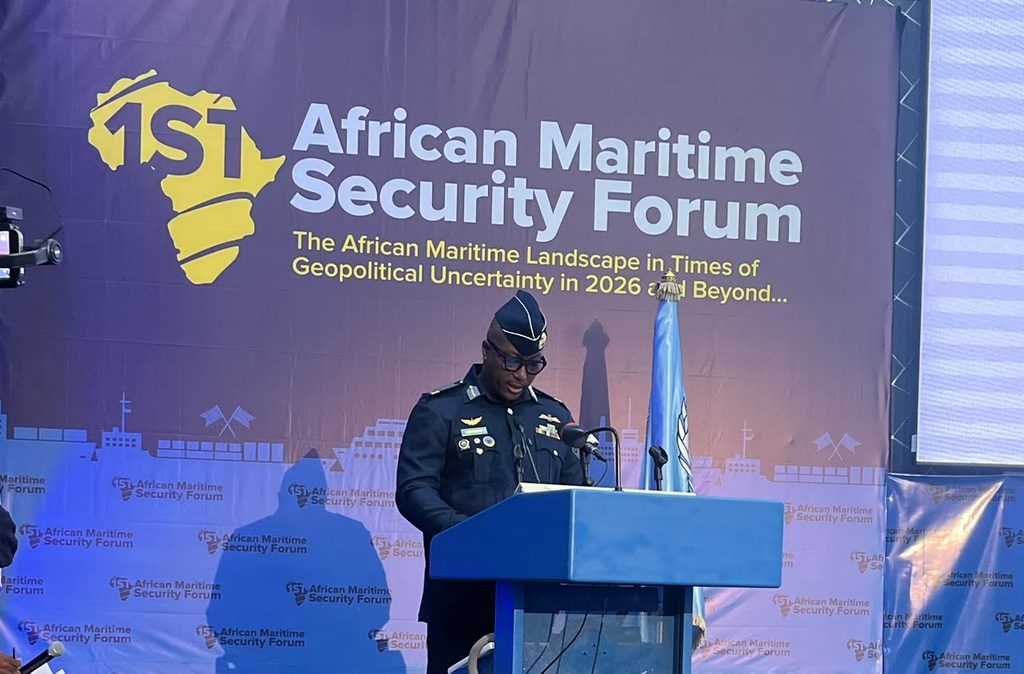
Air Vice Marshal David A. Akrong, the Commandant of the Kofi Annan International Peacekeeping Training Centre (KAIPTC), has urged for a unified approach to tackle Africa's maritime security challenges. In his address at the inaugural African Maritime Security Forum in Accra, he highlighted how geopolitical tensions, organized crime and shifting shipping routes are posing increasing threats to coastal states across the continent.
Akrong pointed out that the forum's scope extending beyond the Gulf of Guinea underscores the fact that maritime security no longer respects regional borders.
He emphasized that the new platform would facilitate the sharing of security discussions encompassing the Gulf of Guinea, southern African sea lanes, and the western Indian Ocean, enabling countries to devise coordinated strategies to address shared threats. The forum, themed "The African Maritime Landscape in Times of Geopolitical Uncertainty in 2026 and Onwards," convened maritime security professionals, naval leaders, scholars, and international partners to explore emerging threats and devise actionable policy recommendations.
While acknowledging a significant decline in piracy incidents in the Gulf of Guinea, attributed to regional frameworks and cooperation, including the Yaoundé Architecture, Akrong warned that the root causes of maritime insecurity remain unresolved. These include inadequate law enforcement capabilities, weak coastal governance, youth unemployment, environmental degradation, and marine pollution.
He also warned about renewed piracy threats in the Somali Basin and western Indian Ocean, alongside transnational organized crime involving smuggling, trafficking, and illegal fishing.
Akrong further cautioned that geopolitical tensions and instability outside Africa's immediate region were directly affecting the continent's maritime environment. He pointed out the impact of disruptions around critical international shipping lanes, such as the Red Sea, Bab el-Mandeb, and the Strait of Hormuz, leading to a redirection of global shipping routes towards Africa's southern coastline.
These changes, he argued, underscore the necessity for enhanced maritime domain awareness and cooperation to anticipate and manage the broader security and economic repercussions of global crises.
Akrong called for innovative solutions, increased technology adoption, and robust legal frameworks to confront evolving maritime threats, stressing that responses should tackle the underlying drivers of insecurity rather than just its outward manifestations. The two-day forum aimed to examine the implications of geopolitical shifts for African maritime security governance and develop practical measures to fortify regional and cross-regional policies.
Akrong expressed gratitude to the Government of Denmark for its support and lauded the Royal Danish Defence College and the Security Institute for Governance and Leadership in Africa (SIGLA) at Stellenbosch University for their partnership in organizing the forum. Since 2022, Denmark has supported a maritime security program involving these institutions, convening annual conferences in Stellenbosch, South Africa, initially focusing on the Gulf of Guinea.
Meetings in 2024 and 2025 also addressed developments in the Red Sea and their impact on African coastal states.
This forum represents a broader commitment to ensuring safer seas and a thriving blue economy across Africa. Akrong urged participants to engage in open and constructive dialogues, expressing optimism that enhanced collaboration and practical solutions would safeguard Africa's maritime spaces and promote sustainable economic development.
Written by urgent.news from MyJoyOnline Ghana's reporting — not their text. Machine-written — may contain errors; check the original before relying on it.
This story
This is one outlet's version. Read the fullest account.