Hypersonic missiles drive arms race on Korean Peninsula
SOUTH Korea test-fired its first homegrown hypersonic missile last week, days after the North announced the artificial intelligence-assisted launch of an intermediate-range hypersonic missile.
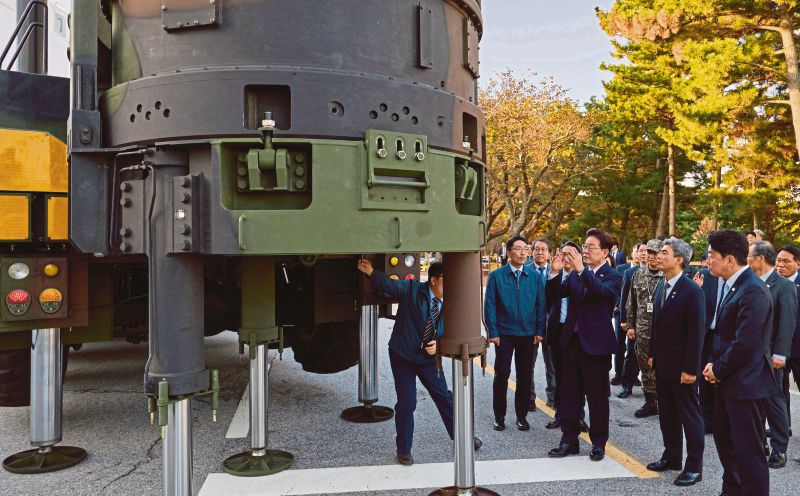
South Korea has recently test-fired its first homegrown hypersonic missile, following North Korea's announcement of an AI-assisted intermediate-range hypersonic missile. Hypersonics travel at speeds of at least five times the speed of sound, which is more than 6,100 kilometres per hour. These weapons reduce response time, can carry conventional or nuclear warheads, and potentially alter the strategic balance due to their unpredictable flight paths and potential to evade detection by conventional missile defence systems.
Hong Sung-pyo, a senior researcher at the Korea Institute for Military Affairs, stated that hypersonic missiles' ability to change course mid-flight makes them harder to track and intercept compared to conventional ballistic and cruise missiles. North Korea's leader, Kim Jong Un, reportedly oversaw a hypersonic missile launch using artificial intelligence, which state media claimed could change its flight path at low altitude and be difficult for South Korea and Japan to detect.
Experts believe that North Korea is still relatively weak in the critical technology needed to maneuver hypersonic missiles in their final stages while maintaining strike accuracy. However, North Korea may be conducting test launches to perfect this capability, with assistance from Russia.
South Korea's test of its first hypersonic missile is seen as a strategic asset capable of changing the course of the battlefield, according to the presidential Blue House. The test also serves as a political move, signaling to potential adversaries that South Korea has a range of weapons options and that attacking it would not be easy.
The test launch has multiple audiences, including North Korea, the South Korean public, and neighboring countries, according to Jung Heon-joo, a public policy professor at Yonsei University.
North Korea also fired multiple ballistic missiles from its east coast on Monday, potentially aiming to complicate the ability of South Korean and US defense systems to respond. Analysts believe that the pursuit of hypersonic weapons by both Koreas could fuel an arms race on the peninsula, with implications for US and Japanese defenses.
Written by urgent.news from New Straits Times's reporting — not their text. Machine-written — may contain errors; check the original before relying on it.