Energie: Wie die Gasspeicher künftig verlässlich gefüllt werden könnten
Die Gasspeicher füllen sich nur langsam. Das Wirtschaftsministerium überlegt, mit welchen Instrumenten ein höherer Füllstand erreicht werden könnte. Die Branche verweist auf Frankreich.
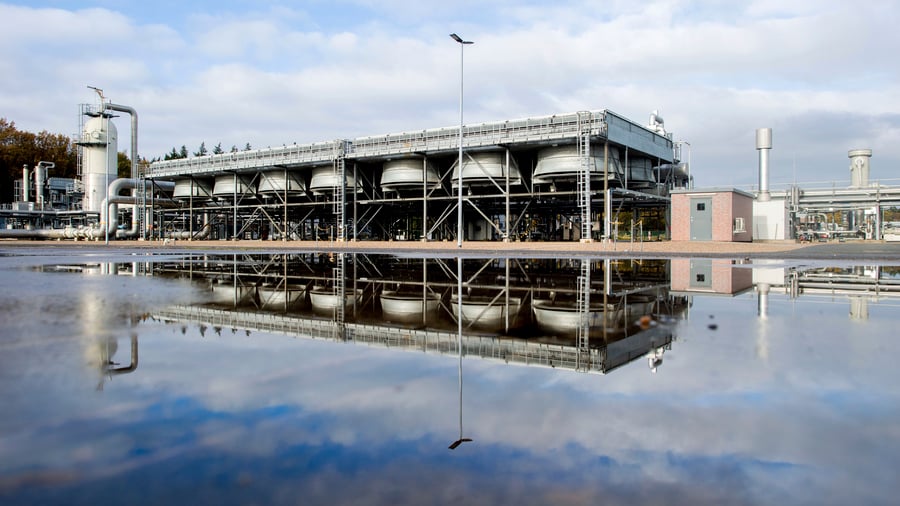
The low level of gas storage fills remains a problem for Germany's supply. The filling level continues to be below the average of previous years. The Federal Ministry of Economics is open to demands that link the booking of storage capacity with the obligation to physically store the gas. Bernhard Kluttig, responsible department head, said recently at the annual Gas trade fair in Berlin that this is a point that should be discussed.
Capacity bookings have often proven to be deceptive in the past. Federal Minister for Economics Katherina Reiche (CDU) has also occasionally pointed out that the storage is well booked, but this does not guarantee that the bookings will actually be used. Image-wise, someone throws a towel on the pool lounge and does not use the lounge.
Would it make a difference to link the bookings with the obligation to actually store gas? Uniper points to France. Within the industry, there is a consensus. Uniper, the state-owned energy company, says that a filling obligation could be a meaningful building block and contribute to filling the storage to a higher extent by winter.
"What matters is that it is clearly regulated who is obliged, what level of risk mitigation is achieved, and how the obligation interacts with the retention of sufficient storage capacity." Uniper, the largest German gas importer and largest gas storage operator, also looks at the filling obligation from a different perspective and has long advocated the French model.
In France, storage operators receive a part of the economic risk. If their revenues do not cover the costs, the gap is closed through a levy system. Funded by a surcharge on the fees that consumers pay for using the gas networks. A significant challenge next year: As a result, storage operators will also earn a "regulated return" similar to the operators of electricity and gas networks.
Meanwhile, customers are obliged to use booked storage capacity. They may not fall unused. Sebastian Heinermann, CEO of the Verband Ines, which groups the storage operators, welcomed the openness of the Federal Ministry for structural reforms in the storage market. "We should timely conduct the discussion on storage obligations initiated by the Ministry and focus on their concrete design to put storage fills on a reliable basis as quickly as possible," he said.
The expected strong depletion of German gas storage in the coming winter and the planned establishment of a strategic gas reserve would pose fresh challenges to filling again next year. Reiche had announced a few months ago that she intended to build a strategic gas reserve. However, the reserve should be considered separately from market developments and used only for exceptional crises, such as a disruption of the gas supply infrastructure.
The legal framework is still in development. The reserve is expected to be available from the winter of 2027/2028. Gas storage has fundamentally changed, according to David Bothe from the consultancy Frontier Economics. A filling obligation would encroach on the entrepreneurial freedom of gas traders and specify their procurement strategy.
On the other hand, experiences from other European countries show that such instruments could work. Frontier Economics analyzed the impact of filling capacity requirements for gas storage in a paper published at the end of October last year for the Federal Ministry of Economics. After the Ukraine war, gas storage fundamentally changed.
In the years before the withdrawal of Russian pipeline gas deliveries, filling of storage was solely dictated by market laws: Gas prices were lower in spring and summer due to lower demand, so it made sense for gas traders to start storing gas in spring to sell it again with a markup in the fall. However, this mechanism no longer works.
The difference between summer and winter prices, the so-called "summer-winter spread", has even reversed in some cases: Gas is sometimes more expensive in spring and summer than in winter. This eliminates the incentive to store gas in the summer. THE has called for Long Term Options The reason is that the market has become global.
After the withdrawal of Russian pipeline gas deliveries, Germany is now more dependent on the import of liquefied natural gas (LNG), which is in demand year-round worldwide. Seasonal differences have thus blurred. Additionally, the blockage of the Hormuz Strait caused high gas prices in the summer. In recent weeks, Reiche has taken initiatives to increase the fills.
In September, she ordered the state-owned gas distributor Sefe to buy eight terawatt-hours of gas to fill the storage. Furthermore, the Trading Hub Europe (THE) recently called for Long Term Options (LTOs), which secure gas supplies for the future.
Written by urgent.news from Handelsblatt's reporting — not their text. Machine-written — may contain errors; check the original before relying on it.