China ‘robot trainers’ fold clothes, wash dishes 200 times a day for up to US$900 a month
Across China, a new breed of freelance “robot trainers” are wearing motion-capture gear to turn everyday household chores – picking up cups, opening bottle caps and washing dishes – into data that will teach tomorrow’s machines. The data is later converted into training sets to help robots work in settings ranging from kitchens and factories to supermarkets. Such roles are increasingly advertised…
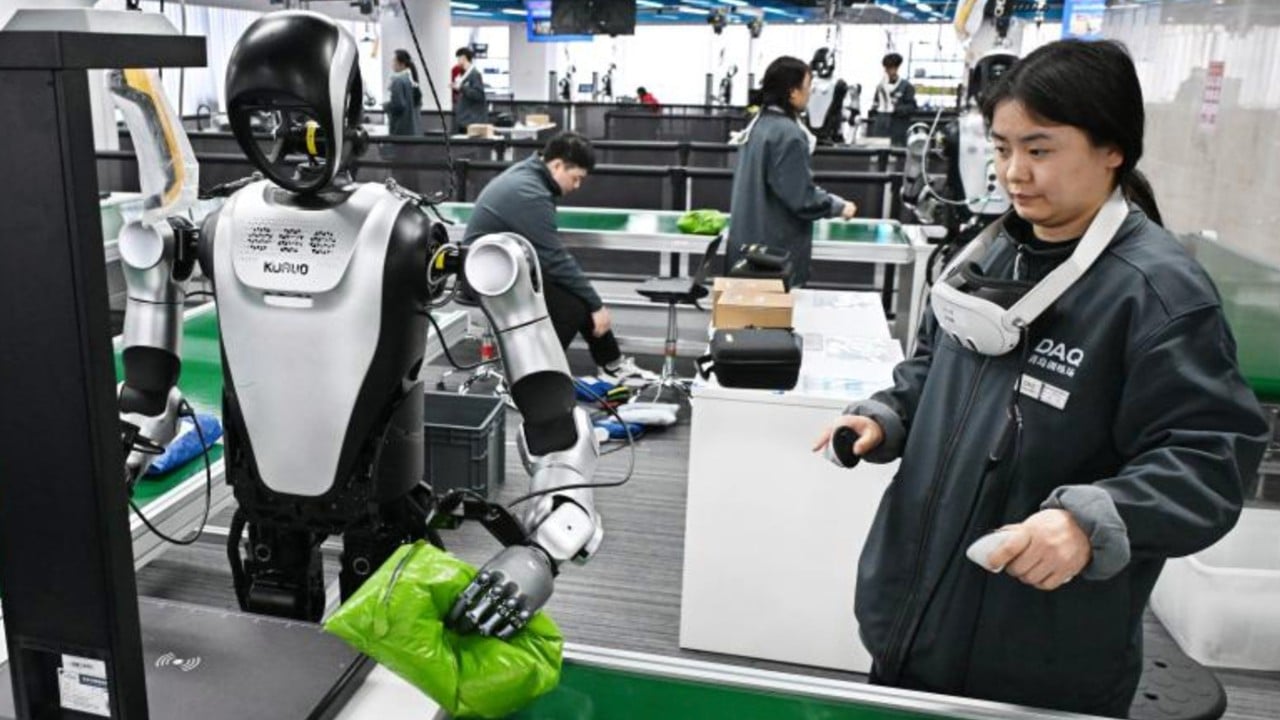
In China, a new class of freelancers known as "robot trainers" are transforming routine chores into data to train future robotic systems. These tasks encompass picking up objects, opening caps, and washing dishes, among others. The collected data forms crucial training sets that enable robots to function effectively in diverse environments, such as kitchens, factories, and supermarkets.
These roles are widely promoted on Chinese social media and job platforms, offering monthly pay ranging from 4,000 yuan to 6,000 yuan (approximately US$600 to US$900). They appeal to unemployed individuals and young people seeking adaptable employment opportunities.
Liu Yun, a 40-year-old former automotive industry worker, joined the profession after facing difficulties in finding new employment due to her age. At a Beijing studio, she donned a sensor bracelet and finger-mounted chips, following on-screen instructions while repeating movements like moving cups and scrubbing surfaces. Liu likened her experience to teaching a two-year-old, with the studio monitoring her productivity and accuracy on large screens.
The daily objective was to record 160 samples, while the highest achievers completed over 260. Despite the repetitive nature of the work, Liu found it exhausting, as washing dishes and wiping tables 200 times a day pushed her limits.
Sun, a 22-year-old student from Shanxi province, took on the job during his summer break while searching for an internship. His duties included folding clothes, sweeping floors, and recording standardized movements for robot training. Sun earned 120 yuan (US$18) for a day shift and 135 yuan (US$20) for a night shift, but the high turnover rate indicated that many workers left after only a few weeks. Sun acknowledged that the income did not compensate for the physical and mental demands of the repetitive tasks.
For others, the job offers flexibility. Guo Hongjuan, from Jiangsu province, conducts her work from home for around six hours a day, collecting data through tasks like arranging books, wiping tables, and moving objects. She earns approximately 4,000 yuan (US$570) monthly and values the arrangement for its ability to allow her to balance work with childcare.
The practice of gathering human labor data extends beyond household chores. In August, Shenzhen-based tech firm Physen AI collaborated with a sanitation company to provide street cleaners with data-collection devices. As workers swept roads and responded to interruptions, such as encountering electric bicycles, their movements were recorded to assist robots in better understanding real-world scenarios.
The emergence of robot trainers has sparked diverse reactions online. Some users humorously dubbed it a "cyber assembly line," while others characterize it as "home-based migrant labor." One middle-aged worker mentioned that after three months of low-paid robot-training work, he at least gained insights into performing household chores. Another online user expressed irony, noting that humans are teaching robots to work, yet those machines may eventually replace the very workers who trained them.
Written by urgent.news from South China Morning Post's reporting — not their text. Machine-written — may contain errors; check the original before relying on it.