Chandrasekhar Placed A Limit On White Dwarfs, But A New Study Finds This Limit Is Not Absolute
The Chandrasekhar limit states that a white dwarf can be no larger than 1.4 solar masses. A new study demonstrates how highly magnetized white dwarfs could overcome that limit, and how such super-Chandrasekhar white dwarfs could form.
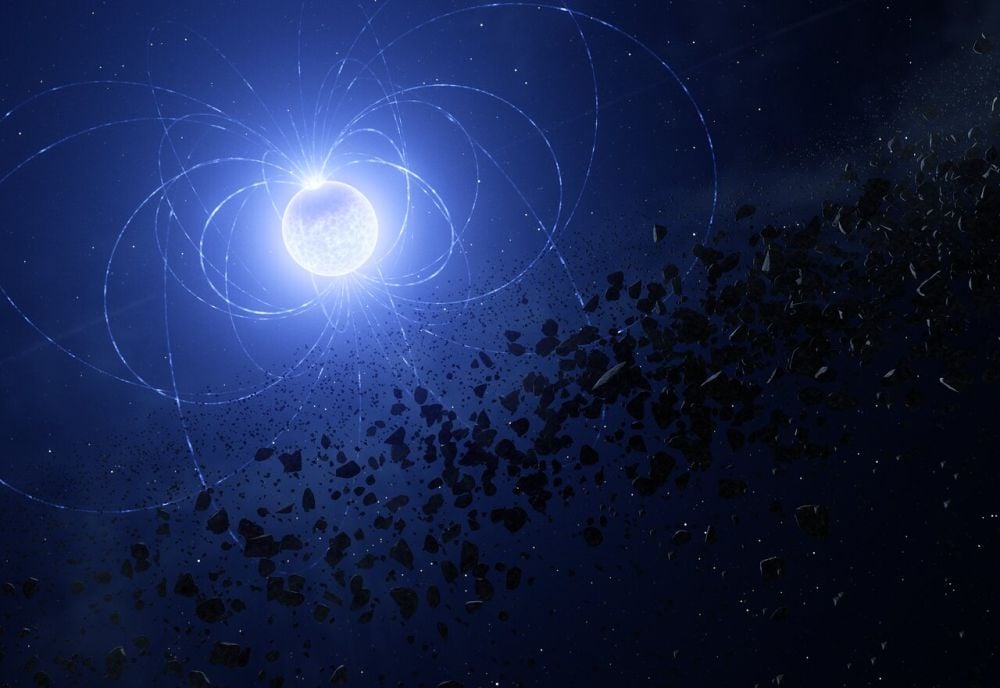
In the 1930s, Subrahmanyan Chandrasekhar established a fundamental limit on white dwarfs, determining that they could not exceed 1.44 solar masses. This limit, known as the Chandrasekhar limit, is grounded in the interplay of gravity and electron pressure. Despite numerous attempts by theorists to overcome this limit, observational evidence consistently supported Chandrasekhar's prediction.
Type Ia supernovae, triggered by the collision of two white dwarfs, relied on this limit for their predictable behavior. However, in 2003, the Supernova Legacy Survey observed a supernova that appeared to surpass Chandrasekhar's limit. This anomaly prompted further investigation, leading to a recent study in The Astrophysical Journal Letters that examined the role of magnetic fields in breaking this limit.
The study found that a highly magnetized white dwarf could potentially reach nearly three solar masses before collapsing. By incorporating the effect of magnetic fields into stellar evolution simulations, researchers discovered that a Sun-like star does not necessarily need to be strongly magnetized to form a white dwarf with a magnetic field.
The magnetic field becomes concentrated as the core collapses, allowing a magnetized white dwarf to form from a typical star. This research suggests that magnetized white dwarfs might be more common than previously assumed, potentially explaining the observed size of certain white dwarfs and the 2003 supernova anomaly.
Written by urgent.news from Universe Today's reporting — not their text. Machine-written — may contain errors; check the original before relying on it.