Cat-Like Whiskers Help Tiny Drones Fly in the Dark
Researchers took lessons from nocturnal animals to help rescue drones overcome a key challenge: flying in the dark.
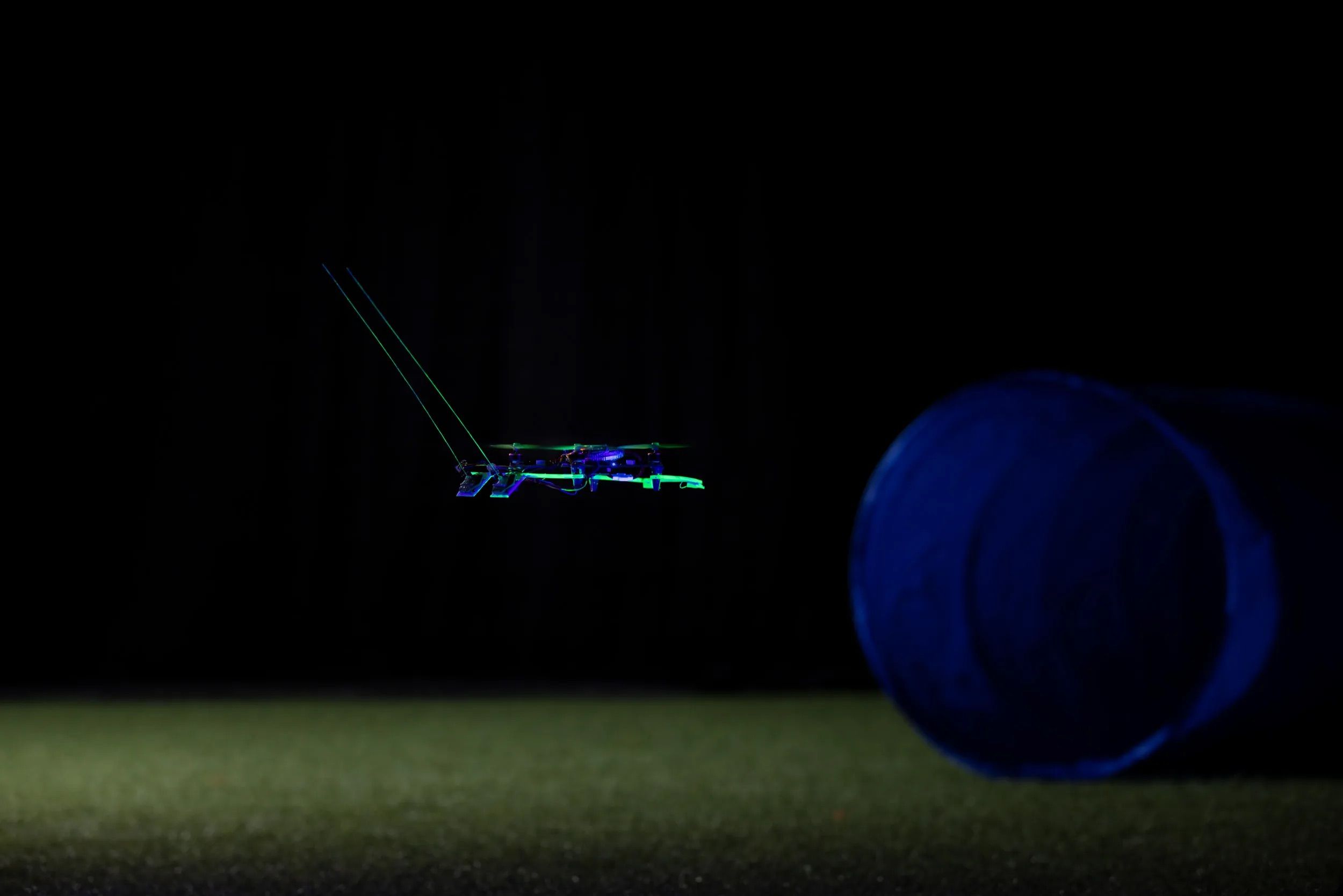
Weighing less than a stick of butter, ultra-compact drones struggle to function in poor lighting or smoky environments due to limited sensor capabilities. To overcome this, a research team at Delft University of Technology in the Netherlands, inspired by the whiskers of nocturnal animals, developed a lightweight tactile sensor for drones. This innovation allows the drones to navigate even when they cannot "see."
Whisker-based navigation is a novel concept for drones, presenting challenges such as ensuring lightweight, low-latency, and low-power operation. To address these challenges, the team crafted delicate nickel-titanium wires measuring 0.4 millimeters in diameter and attached them to the drone as "whiskers." These whiskers, each nearly 8 inches long with three pressure sensors at the base, help the drone estimate its distance from and position in relation to nearby barriers.
The researchers tested 72 flights with six different angles at three different speeds, ultimately adopting a 45-degree angle for optimal performance. They also developed a correction algorithm to minimize false positives caused by sensor drift and vibrations from the drone's propellers. In tests using transparent walls, the drone successfully maintained a safe distance from walls and navigated around obstacles, even when walls were at an angle.
However, the researchers acknowledge that further improvements are needed, particularly for real-world applications where obstacles are less predictable. The entire tactile perception pipeline runs onboard the drone using just 34 KB of memory, demonstrating that touch-based navigation does not have to compromise size or computational power.
Written by urgent.news from Wired's reporting — not their text. Machine-written — may contain errors; check the original before relying on it.