Astronomers Uncover More Intriguing Detail in an Ancient Supernova Remnant
When a supernova exploded in 1181, Chinese and Japanese sky-watchers recorded it. They couldn't have known what the object was, and why it appeared for six months then disappeared. But in our modern times, we know it was a supernova, and we've even, most likely, found its remnant. New observations reveal more detail than ever in the unusual and rare supernova remnant.
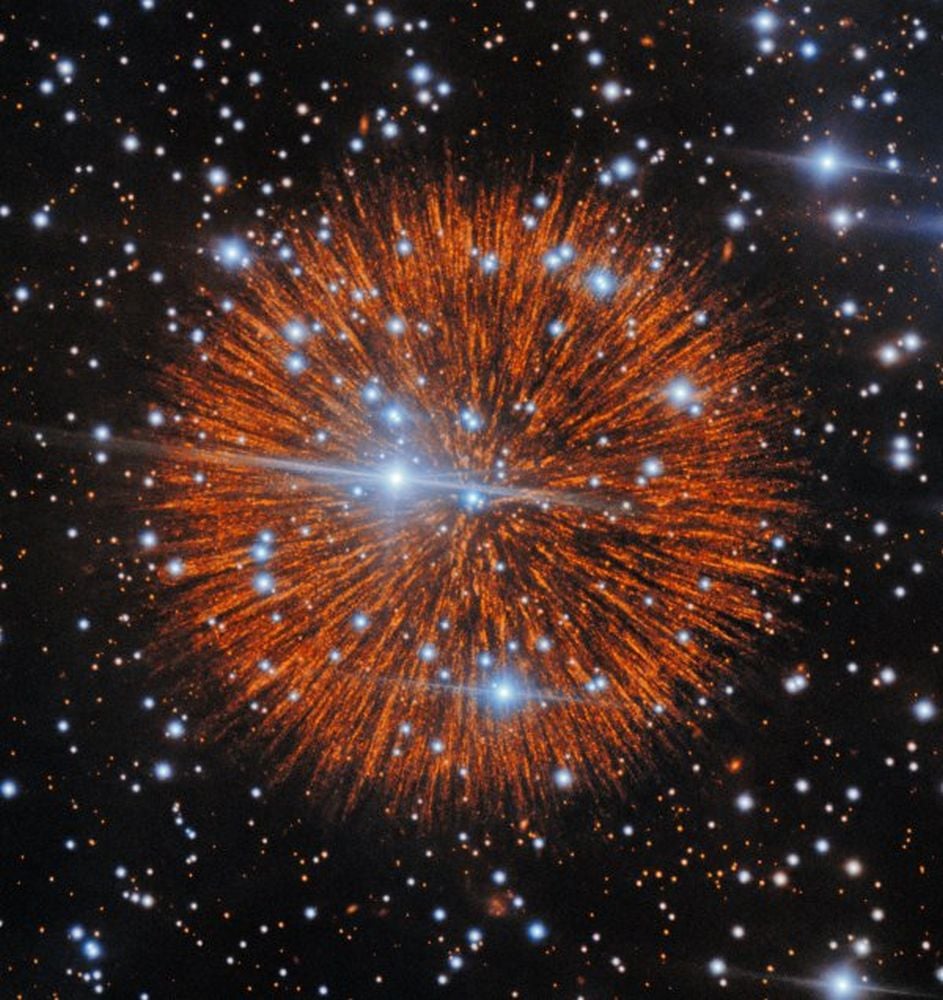
In 1181, Chinese and Japanese astronomers and diary keepers recorded a mysterious guest star in the constellation Cassiopeia. Though they did not realize it at the time, this was a supernova, an exploding star. Recent research using the Gemini North Telescope and its Gemini Multi-Object Spectrographs (GMOS) instrument has uncovered new details about the supernova remnant's (SNR) structure.
This remnant, named Pa30 or IRAS 00500+6713, appears to have been formed by the merger of two white dwarfs, resulting in a Type Iax supernova, rather than a core-collapse supernova.
The researchers found that the SNR contains an extraordinary number of filaments, with an order of magnitude more filaments than previous observations. These filaments are not smooth radial streaks, but instead are composed of cascades of knots or clumps. The finer detail in the images is due to the proximity of Pa30 to Earth, making it a unique target for study.
Unlike other observed remnants, Pa30's central white dwarf is unusually massive (about 1.5 solar masses) and very hot (around 200,000°C) with stellar winds moving at an incredible velocity of approximately 16,000 km/second.
The white dwarf in Pa30 is a super-Chandrasekhar white dwarf, exceeding the typical limit of 1.4 solar masses. Moreover, its position in the very center of the nebula is highly unusual, as most white dwarfs are kicked out of the SNR's center by the explosion. This centrally-located remnant suggests that Pa30's white dwarf did not receive a substantial kick from the SN explosion, which is extremely rare for such objects.
The unusual features of Pa30 provide valuable constraints on the models explaining its morphology and can help astronomers understand its progenitor better.
Written by urgent.news from Universe Today's reporting — not their text. Machine-written — may contain errors; check the original before relying on it.