APOD: 2026 October 14 – Mars and the Beehive Under an Aurora
What a cosmic coincidence! In today’s image, Mars joins the Beehive cluster below an auroral curtain and above a horizon of happy little trees near Lansjärv, Sweden.
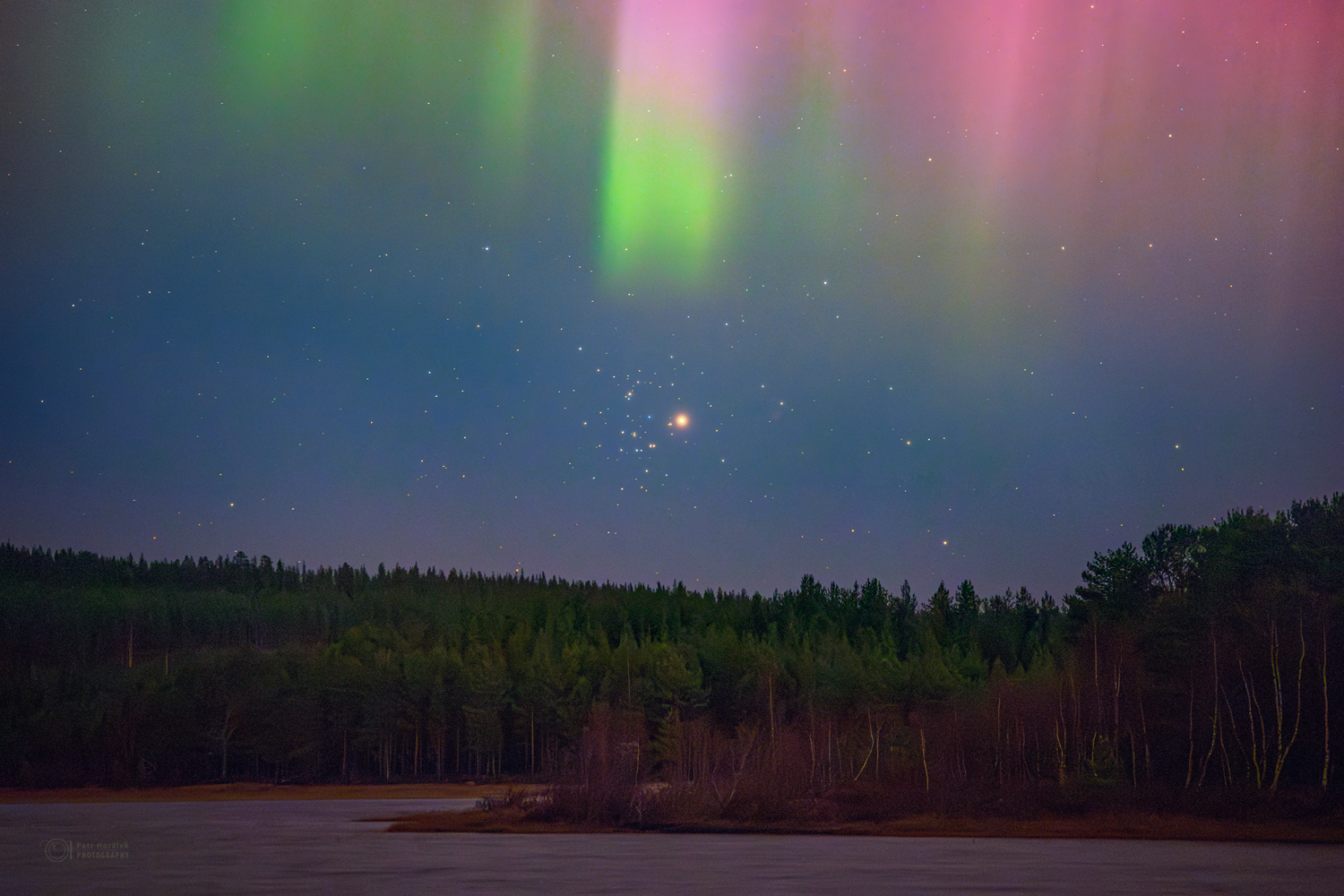
On October 14, 2026, an extraordinary celestial event unfolded over Lansjärv, Sweden. Mars and the Beehive cluster, also known as M44 or Praesepe, appeared together, illuminated by a vibrant auroral display in the night sky. The coincidence was striking, as Mars lay near the heart of the Beehive cluster, while a dazzling curtain of aurora graced the horizon above a grove of trees.
The cause of this spectacle was a solar eruption that had struck Earth on October 10, 2026. The powerful eruption unleashed high-energy particles that interacted with Earth's magnetic field, generating the mesmerizing aurora. These particles collide with atmospheric molecules, exciting them and causing them to release energy in the form of light, creating the captivating auroral curtains.
The Sámi people of Sweden, indigenous to the region, have long held a deep respect for auroras. Known as guovssahasat in their language, these celestial displays are traditionally viewed with reverence and awe. In this particular instance, the alignment of Mars with the Beehive cluster added an additional layer of wonder to the already breathtaking sight.
Interestingly, Mars had reached its closest point to the center of the Beehive cluster in the sky at this moment. The Beehive cluster, officially designated M44 or Praesepe, is a collection of young stars. While bees have been sent into space, the Beehive cluster is, in fact, a stellar nursery, with its constituent stars rotating at varying periods. Studying the rotation of these stars has been instrumental in understanding how stars gradually slow down as they lose mass through stellar winds over time.
This remarkable view of Mars and the Beehive cluster under an aurora, captured on October 14, 2026, will be featured as the Astronomy Picture of the Day. The image was provided by Petr Horálek of the Institute of Physics in Opava, alongside contributions from Josef Kujal and Vojan Höfer. This captivating snapshot of our universe serves as a reminder of the astonishing beauty and intricate dynamics that exist beyond our planet.
Written by urgent.news from NASA Science's reporting — not their text. Machine-written — may contain errors; check the original before relying on it.
This story
This is one outlet's version. Read the fullest account.
- APOD: 2026 October 14 – Mars and the Beehive Under an Aurora science.nasa.gov