Urgent.News

What's breaking now, across thousands of outlets.

Tech

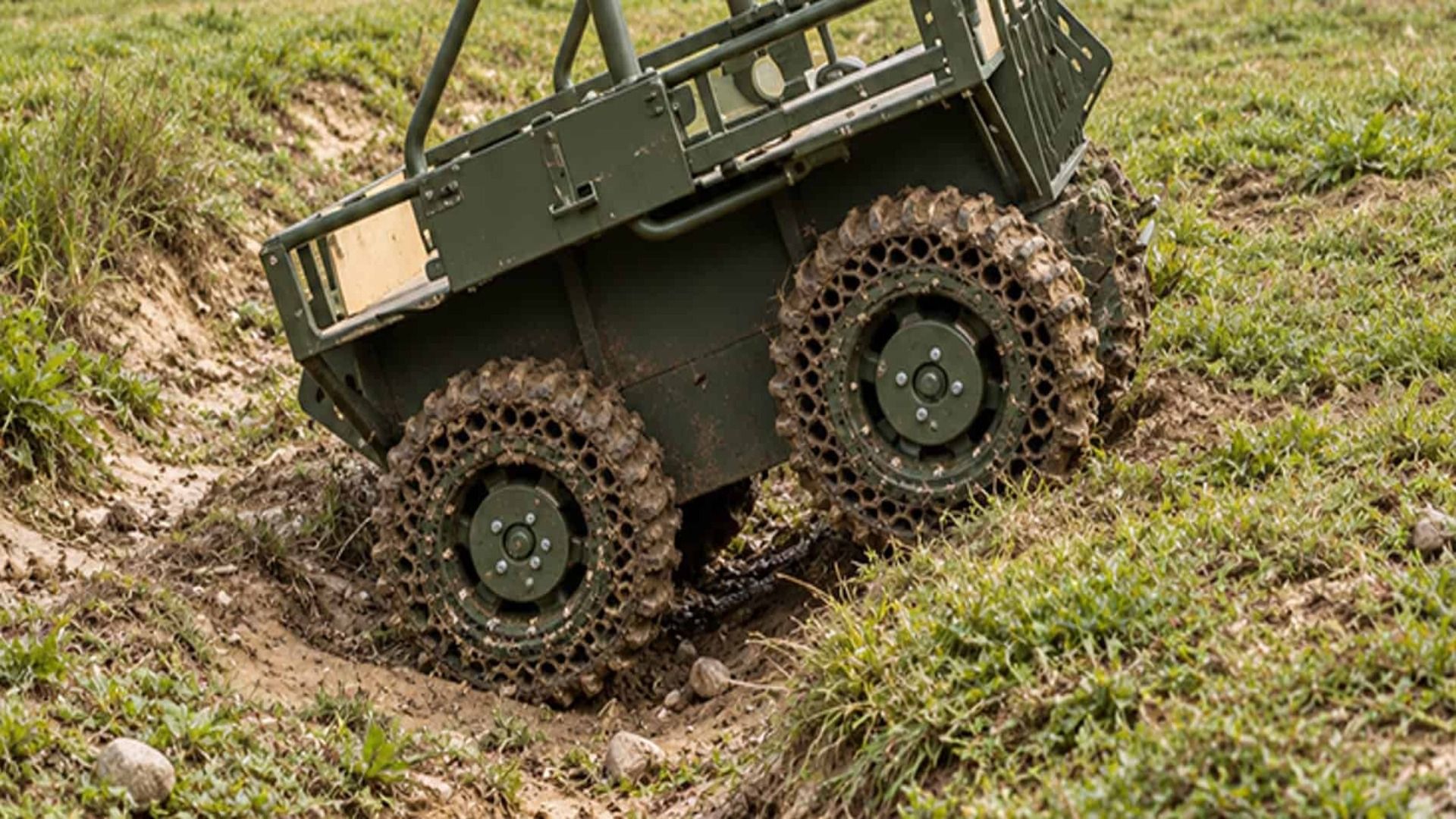
3D-printed airless wheels could be a game changer for Ukraine's ground robotic vehicles — ultralight no-deflation tyres improve resistance to punctures and explosions

Print&Live and iSCALE 3D developed an airless robotic wheel weighing 32–56 kg per set, with production underway for Ukrainian combat units.
3D-printed airless wheels could be a game changer for Ukraine's ground robotic vehicles — ultralight no-deflation tyres improve resistance to punctures and explosions

Ukrainian engineers have developed 3D-printed airless wheels for ground robotic vehicles, which could significantly enhance their performance in combat conditions. These ultralight wheels, weighing between 32 and 56 kg, eliminate the need for inflation, making them more resistant to punctures and explosions. The novel design incorporates a rounded tread, closed profile, and a two-piece disc, featuring a lattice made from durable elastomers and composite polymers.

By omitting internal air pressure, the wheels maintain their supporting function without the risk of failure due to debris, blast effects, or unforgiving terrain. The innovation aims to extend the operating range of robotic platforms by up to 30% compared to foreign alternatives, while also reducing unsprung and rotating mass. This could ultimately ease mechanical demands on robotic equipment's gearboxes and electric drive systems.

Once manufactured, the wheels can be digitally customized according to a robot's weight and operating needs, simplifying the development of specialized variants. Additionally, the patented two-piece rim allows for easy replacement or repair without requiring specialized machinery, potentially easing field servicing in combat zones.

The project has successfully completed its research and development phase, with production now underway in limited quantities for delivery to combat units. However, further independent testing is necessary to evaluate the wheels' performance in sustained use, repeated impacts, and varying battlefield conditions.

Written by urgent.news from TechRadar's reporting — not their text. Machine-written — may contain errors; check the original before relying on it.

Read the original at techradar.com →

More in Tech

Why Daily Stand-Ups Fail: Adapting Agile Ceremonies to Team Context

Walk into almost any engineering department, and you will see it. It is 9:15 AM. Eight developers are staring blankly at a Zoom grid or standing in a circle, waiting for their turn to mumble…

  • Daily stand-ups often fail due to lack of adaptation to team context.
  • Team maturity determines effectiveness of formal stand-ups.
  • Asynchronous check-ins are more effective for distributed teams.

The Persistence Layer — Or, the Daemon You Never Agreed to Run

Last time I named the exit as its own layer (#58) — the cost of leaving is the layer that decides whether "own" was ever a choice.

  • Persistent daemon installed by default, runs silently in background.
  • Operates with granted privileges after uninstall, retains access to tokens and keys.
  • Sandboxing proposed to contain autonomous code, prevent unauthorized running.

PowerShell on Legacy Chinese Windows: UTF-8 with BOM or Bust

Windows PowerShell 5.1 does not guess encodings. When it loads a .ps1 file, it looks for a byte-order mark. If it finds one, it decodes accordingly.

  • PowerShell 5.1 fails to auto-detect file encodings
  • Chinese Windows uses GBK code page (CP936) by default
  • Fix involves saving .ps1 files as UTF-8 with BOM

SQL-Migration-Dryrun-Guard: Why Regex-Based Static Analysis Fails to Prevent Production Database Lockups

When performing zero-downtime database migrations on tables containing millions or tens of millions of rows, an unconsidered DDL statement can immediately lead to catastrophic exclusive locks ( ACCESS…

  • SQL-Migration-Dryrun-Guard tool aimed to prevent production database lockups
  • Tool relied on string matching and keyword detection, overlooking complex DDL cases
  • Architectural weaknesses: static analysis limitations and lack of handling subtransactions

More from Wednesday 14 October →