Will the Hubble “constant” ever become an actual constant?
It was nearly a full century ago that enough data came in to map out both the distance to a significant number of extragalactic objects and also measure the amount that their light was redshifted: interpreted as an apparent recession speed away from us. When the distance and recession velocity of those objects were plotted against one another, an intriguing relationship emerged: the farther away…
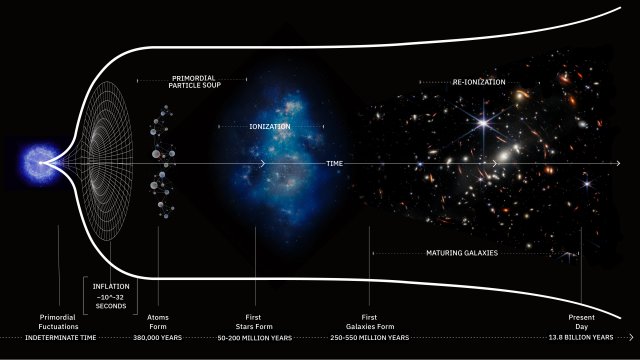
Nearly a century ago, enough data was collected to map out the distances to numerous extragalactic objects and measure the redshift of their light. This redshift was interpreted as an apparent recession speed of the objects away from us. When the distances and recession velocities of these objects were plotted together, a linear relationship emerged: the farther away we looked, the faster an object seemed to be moving away.
This relationship, known as Hubble's Law or the Hubble-Lemaître Law, has the slope as the Hubble constant.
However, this Hubble constant is a misnomer since the expansion rate of the Universe changes over time and isn't even constant in space at the present moment. The prediction of the variation in time came from Einstein's theory, but the variation in space was a surprise and only became clear with the discovery of dark energy. Dark energy may ultimately be the key to the Hubble constant's fate. If it is indeed a cosmological constant, the Hubble parameter will become constant far into the future.
The story began in the 1920s when advancements in telescope technology allowed astronomers to resolve and identify individual stars in galaxies beyond the Milky Way. Edwin Hubble identified the first such star, a Cepheid variable in the Andromeda galaxy, in 1923. Cepheid variables have a well-known relationship between their intrinsic brightness and the time it takes to brighten and fade.
By comparing the observed brightness of these stars with their intrinsic brightness, astronomers could measure their distance. This "standard candle" method has become a crucial tool for determining distances in astronomy.
Observationally, the relationship between distance and redshift (a measure of recession speed) is consistent across the Universe, from nearby galaxies to objects billions of light-years away. Originally, Hubble's plot of distances versus redshift showed this relationship, followed by more modern versions from around 70 years later.
The key to uncovering the expanding Universe relied on spectroscopy, which breaks light into its component wavelengths, revealing absorption and emission features. By analyzing these features, astronomers can determine an object's redshift and calculate its recession speed.
Written by urgent.news from Big Think's reporting — not their text. Machine-written — may contain errors; check the original before relying on it.