Why is Gandhi still hated? Ramachandra Guha on the Mahatma’s contested legacy
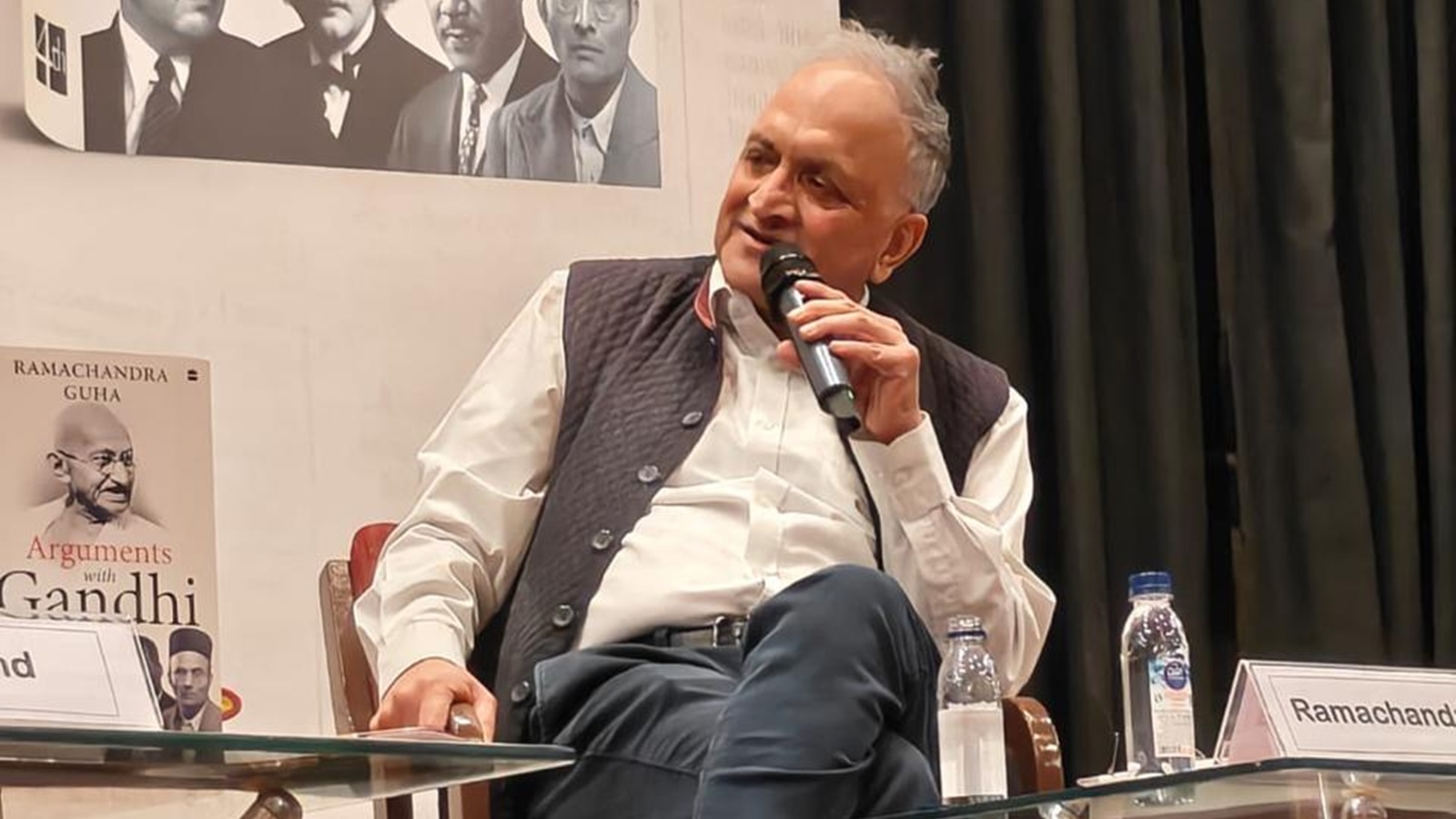
Mahatma Gandhi is widely admired across the globe, yet the question persists as to why many Indians still harbor resentment towards him. During the launch of Ramachandra Guha's book "Arguments with Gandhi" at the India International Centre, the author explored how his life was engaged with by figures such as B.R. Ambedkar, Lenin, Albert Einstein, Martin Luther King Jr., Nelson Mandela, Kamaladevi Chattopadhyay, V.D.
Savarkar, and many others. The arguments surrounding Gandhi ranged from those against him, to those that fought for his ideas, adapted them, or even reinvented them. Shyam Saran, President of the India International Centre, and Bushra Ahmed of HarperCollins inaugurated the book on October 8 at IIC's C D Deshmukh Auditorium, alongside Apoorvanand, who then joined Guha for a discussion.
During the conversation, Apoorvanand quoted French feminist Hélène Cixous, who stated that Gandhi was "hated and still hated in India." Guha concurred, noting that Gandhi's commitment to Hindu-Muslim harmony and his practice of non-violence were what struck at the core of Hindu politics. An argument dates back to 1909 when Madan Lal Dhingra assassinated Sir Curzon Wyllie, a former Indian official in Britain.
This young student was supported by V.D. Savarkar, who believed non-violence to be "ineffective as well as effeminate." Gandhi, who arrived in London soon after the assassination, was horrified and emphasized that India could gain nothing from the rule of murderers, regardless of their race.
Gandhi's approach to non-violence was met with significant opposition not only from the Hindu right but also from the left. In the 1980s, Guha recounted that the most visceral dislike of Gandhi came from Marxists and Naxalites, who considered him a bourgeois stooge who deceived the masses with his philosophy of non-violence to lure them away from the revolutionary path.
One of his "joyful discoveries" while researching the book was a 1970 report which documented 140 attacks on Gandhi statues and portraits by Naxalite students in the year of Gandhi's birth centenary.
The hatred directed towards Gandhi appears to be strongest among upper-caste Hindus. In the 1930s, Gandhi was the only upper-caste leader in the Congress to campaign against untouchability. He called it a sin and labeled those who practiced it as the "General Dyers of Hinduism." Ironically, this campaign nearly cost Gandhi his life when an attempt was made to kill him in Pune in 1934.
Drawing on D.R. Nagaraj's work, Guha argued that the politics of self-purification as proposed by Gandhi and Ambedkar should be seen as complementary rather than adversaries.
Guha highlighted the importance of a new generation that might find a unique understanding of Gandhi, one that differs from the present interpretations. He quoted a remark by an unnamed teacher at Mysore University who stated that Gandhi urged the upper castes to shed their sense of superiority, while Ambedkar urged the Dalits to overcome their sense of inferiority. The discussion concluded with Guha remaining cautious about whether the Poona Pact of 1932 was a success or failure.
Written by urgent.news from The Indian Express's reporting — not their text. Machine-written — may contain errors; check the original before relying on it.