Inside the ‘unique’ tail of Iran’s spider-tailed horned viper
The Iranian spider-tailed horned viper, a rare snake endemic to western Iran, hunts by holding its body completely still while twitching its tail. Its body camouflages among the rocks of its semi-arid Zagros Mountains habitat, but its bulbous tail with accompanying leg-like scales looks remarkably like a large chunky spider. The snake, Pseudocerastes urarachnoides, uses its […]
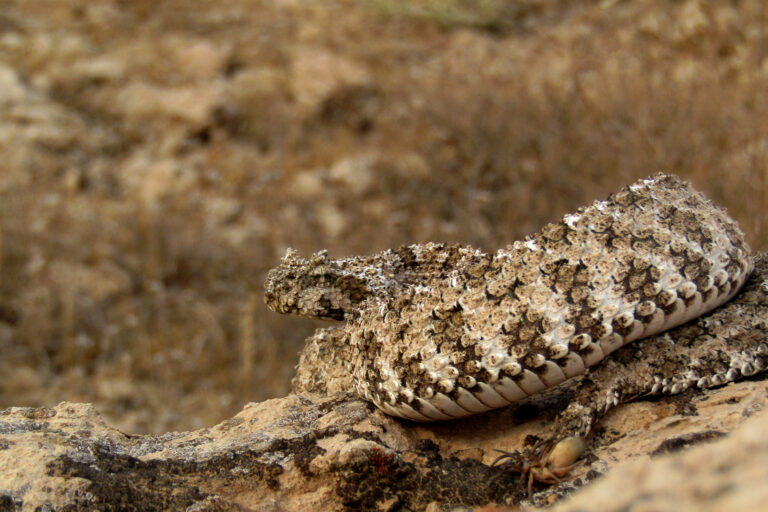
The Iranian spider-tailed horned viper, a rare snake found only in western Iran, employs a unique hunting technique to capture its prey. This snake remains completely motionless, with only its tail twitching, allowing it to blend in with the rocks of its semi-arid habitat in the Zagros Mountains. Its bulbous tail, adorned with leg-like scales, bears a striking resemblance to a large spider, which it uses as a lure to attract unsuspecting mammals and birds.
A specimen collected in 1968 and preserved at the Field Museum of Natural History in Illinois has recently provided new insights into the snake's tail. High-resolution 3D scans of the preserved Pseudocerastes urarachnoides, conducted by a team led by Georgios Georgalis, an associate professor at the Polish Academy of Sciences’ Institute of Systematics and Evolution of Animals in Kraków, Poland, reveal an enlarged and elongated tip to the tail.
This modified scale structure, unique among all living reptiles, serves as an extraordinary lure to unsuspecting prey.
While vipers have long been a subject of interest for researchers, the understanding of their morphology remains incomplete. The description of P. urarachnoides was first published in 2006, but it was only in the current year that a detailed 3D scan of its tail mechanism was published. The tail filaments of this species bear a resemblance to those found in some ornithodiran archosaurs and other forms from the Triassic and Jurassic periods.
However, this does not imply a direct evolutionary relationship; rather, it is likely a result of convergent evolution. Both the modern viper and these ancient reptiles developed similar characteristics due to similar environmental pressures, pushing their evolutionary paths to converge on a similar solution.
Written by urgent.news from Mongabay's reporting — not their text. Machine-written — may contain errors; check the original before relying on it.