India May See Poverty Drop To 12.1% By 2028, Here's What The World Bank Report Reveals
New Delhi: India's poverty rate is projected to decline from 14.2 percent in 2026 to 12.1 percent by 2028, according to the World Bank, although the pace of poverty reduction is expected to slow. The projection, based on the USD 4.2-a-day poverty threshold, reflects improvements in household consumption, employment opportunities and government welfare support. Nearly 50 Crore People Escape…
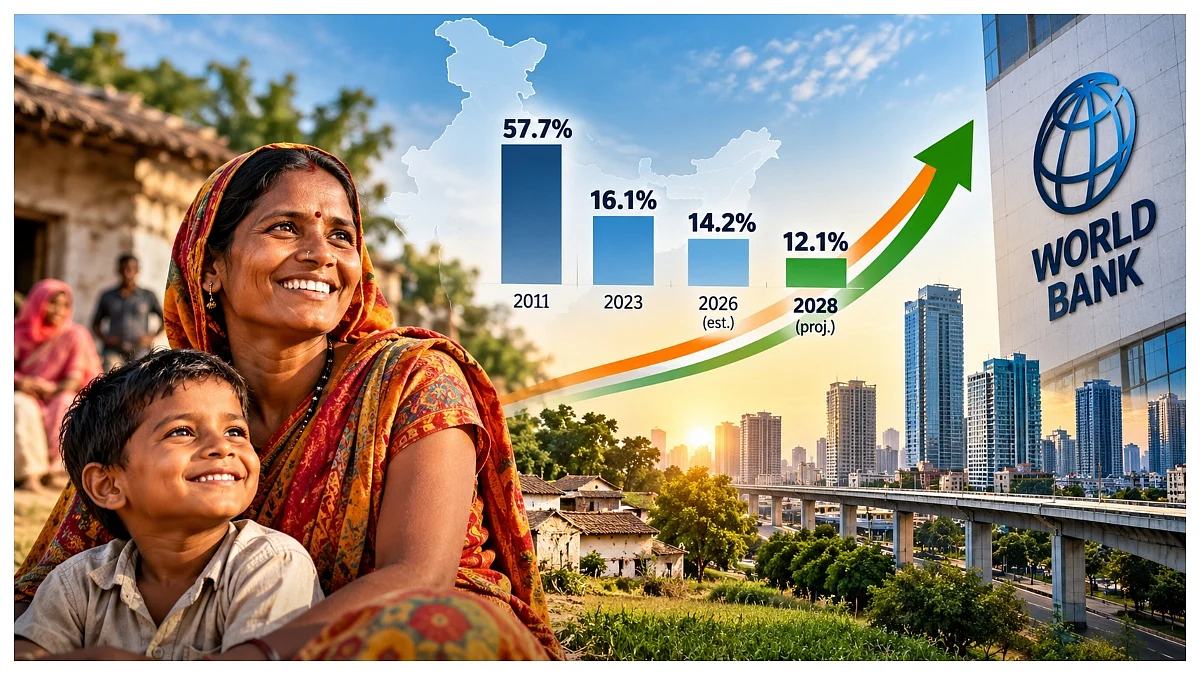
India's official poverty rate is expected to drop from 14.2% in 2026 to 12.1% by 2028, according to a World Bank report. This projection is based on a $4.2-a-day poverty threshold and takes into account improvements in household consumption, employment opportunities, and government welfare support.
According to the World Bank's October 2026 Poverty and Equity Brief, India's poverty rate fell from 57.7% in 2011 to 16.1% in 2023 using a lower-middle-income poverty threshold. This improvement lifted around 49.6 crore (or 49.6 million) people out of poverty during that period.
Roughly 80% of Indians still lived below the upper-middle-income poverty threshold of $8.3 per day in 2023. Poverty remains predominantly rural, with the poverty rate at 19.3% in 2023 compared to 8.6% in urban areas. Sixty-seven percent of India's poor population resides in states like Uttar Pradesh and West Bengal.
Employment growth has supported poverty reduction, with India adding about 13.4 crore (or 13.4 million) jobs between 2017 and 2023, nearly double the increase in its working-age population. Employment growth among rural women played a significant role, boosting household earnings and consumption.
However, most of the job gains occurred in low-productivity sectors, which hasn't led to significant improvements in real wages. Youth unemployment climbed from 14.6% in April-June 2025 to 15.9% in the same period of 2026, with rural women facing a disproportionate impact.
While sustained poverty reduction hinges on higher-paying jobs, stronger productivity, and more economic opportunities, the World Bank cautioned that changes in survey methodology could affect poverty estimates. Consumption surveys might also underreport inequality by not fully capturing spending among wealthier households.
Written by urgent.news from Free Press Journal's reporting — not their text. Machine-written — may contain errors; check the original before relying on it.