IMF's bullish call: Why is India sprinting when the world stumbles?
The IMF has raised India's growth forecast to 7% for both FY27 and FY28, highlighting the country's resilience despite higher oil prices and a slowing global economy. Strong domestic consumption, infrastructure spending, recovering private investment and AI-related capital expenditure are supporting growth, though inflation, energy costs and weaker rural demand remain risks.
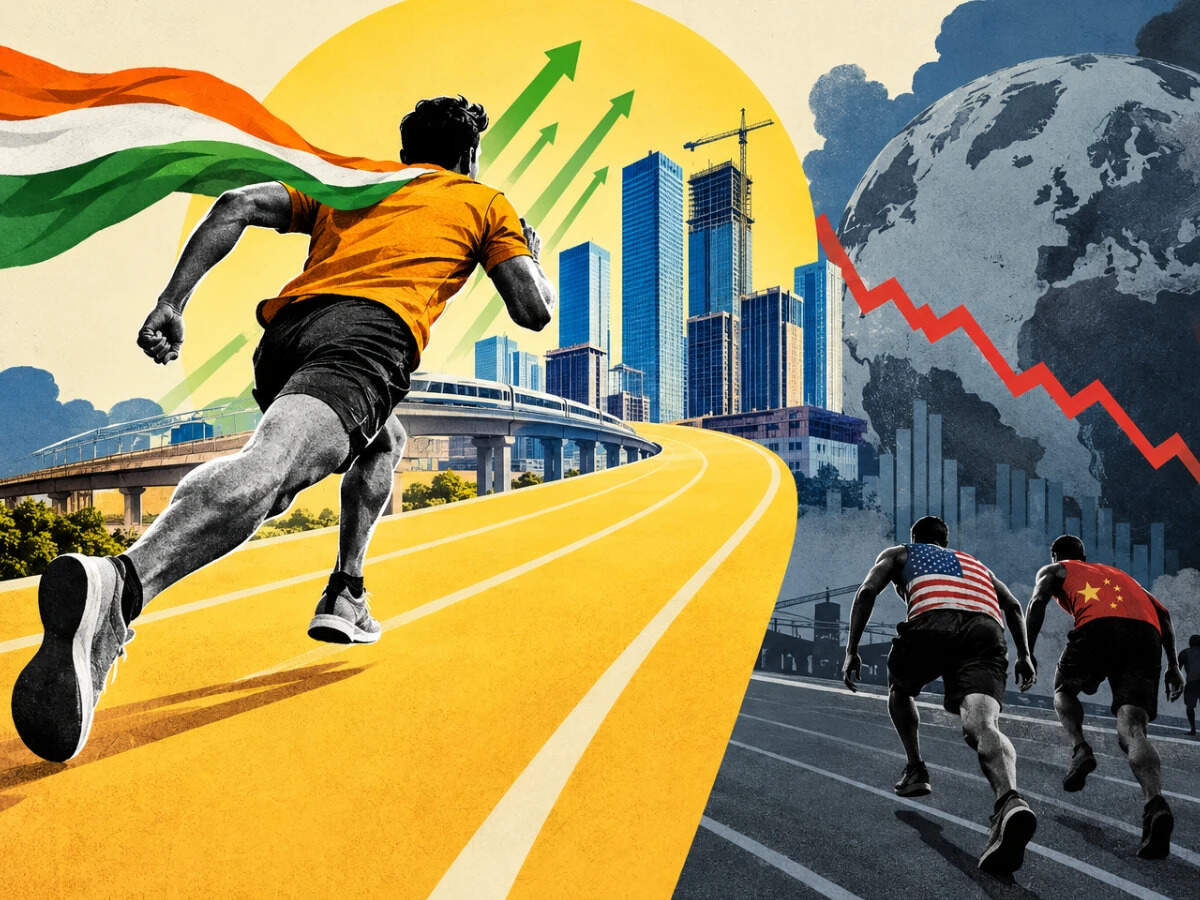
The International Monetary Fund has raised India's growth forecast for 2026 and 2027 to 7%, highlighting a stark contrast to the fragile global economy. While the IMF projects a mere 3.1% growth for the world this year, India has demonstrated impressive resilience, growing 7.8% in the April-June quarter. This rise in growth is attributed to a confluence of factors, including domestic demand, infrastructure investment, stronger corporate balance sheets, and increased private capital expenditure.
Despite risks, India appears more capable of withstanding external shocks than many other forecasters anticipated.
The IMF's World Economic Outlook 2026, titled "Resilience Under Strain, Urgent Choices," underscores the divergent trajectories between India and the rest of the world. While global growth is forecast at 3.1% for 2026 and 3.5% for 2027, the US is expected to see 2.3% growth and China 4.5% and 4.0%, respectively. In comparison, India's 2026 and 2027 growth projections have been raised from 6.4% to 7% and 6.7% to 7% respectively.
Other forecasters, such as the World Bank and Moody's Ratings, have also raised their projections for India, citing stronger momentum and AI-related investment.
India's robust domestic demand forms a crucial cushion against global headwinds. With household consumption growing 7.1% and investment in productive assets surging 11.9%, India's growth is underpinned by a diverse range of sectors, including private consumption, business investment, and exports. The expansion is not solely reliant on government spending or a single booming industry, as evidenced by strong household spending, corporate investment, and despite geopolitical tensions and trade disruptions, exports grew by 12%.
Moreover, India's infrastructure development plays a pivotal role in enhancing its shock absorbers. Since 2014-15, annual central government capital expenditure has nearly sextupled to around Rs 12 lakh crore. Infrastructure projects, such as roads, railways, ports, airports, and power networks, not only support GDP through construction spending but also indirectly bolster industrial production and business expansion through improved logistics, electricity supply, and transport networks. These investments also attract private capital expenditure, creating a virtuous cycle of growth.
Written by urgent.news from The Economic Times - Economy's reporting — not their text. Machine-written — may contain errors; check the original before relying on it.