ESA's Hera Mission Targets Binary Asteroid Pair in November
In just one more month, the European Space Agency’s Hera mission will make history. Moving at 12 kilometers per second versus Earth, the mission is about to rendezvous with the binary Dimorphos-Didymos asteroid pair. NASA’s Double Asteroid Redirection Test (DART) mission slammed into Dimorphos in 2022, and now Hera will provide a follow up view of the mission’s resulting handiwork. The European…
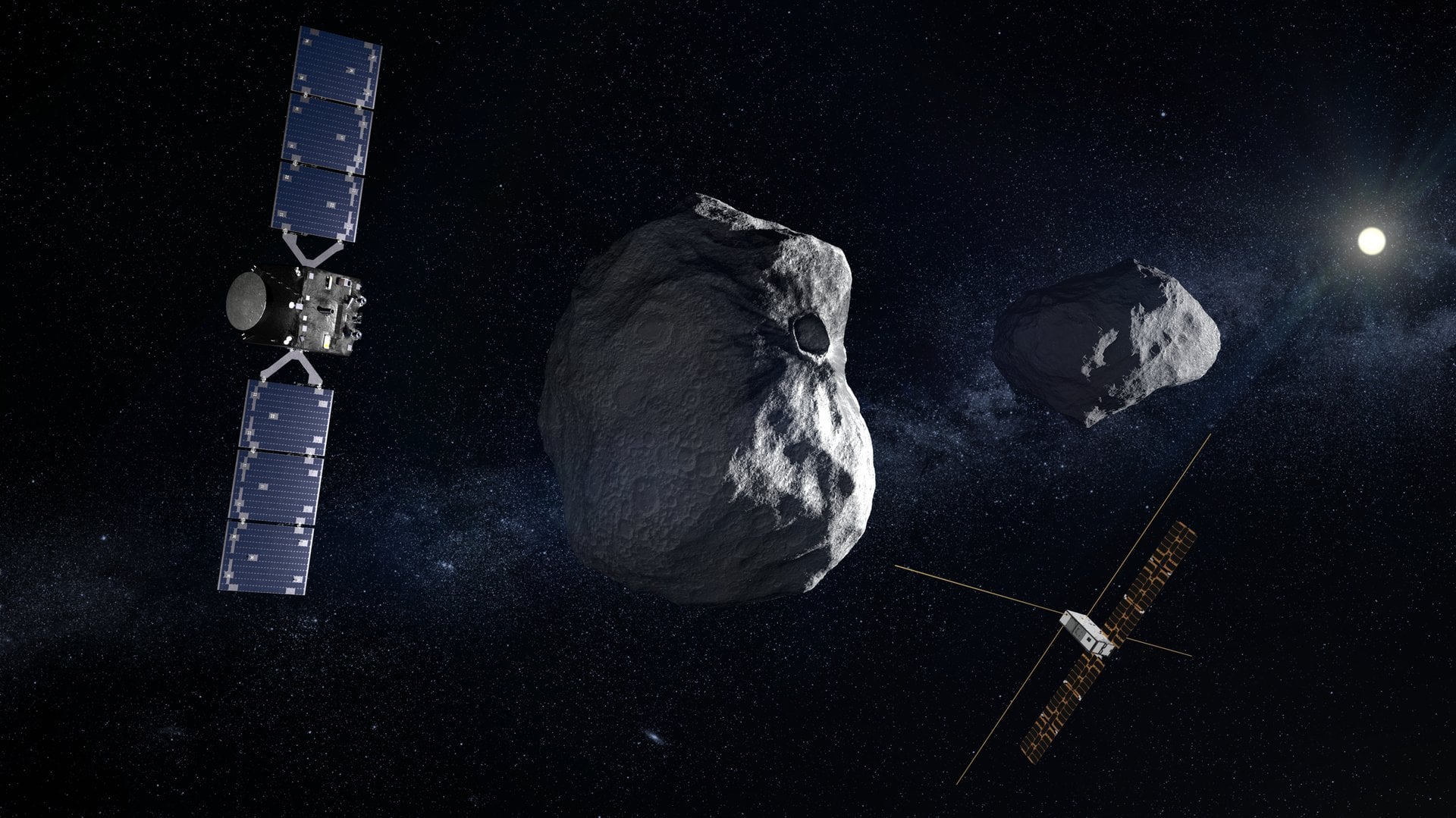
The European Space Agency's Hera mission is scheduled to arrive in just one month at the binary asteroid system of Dimorphos and Didymos. This will be the first time a spacecraft has visited a close binary asteroid pair. The mission is part of ESA's Space Safety Programme and aims to provide new insights into these celestial bodies.
Launched on October 7th, 2024, Hera has taken over two years to reach its destination. The asteroid Didymos, with a diameter of 780 meters, orbits the Sun every 2.1 years. It has a smaller moonlet called Dimorphos, discovered in 2003. Discovered by the Kitt Peak Spacewatch survey, the pair is dim and silicon-rich. The duo is currently about 1.5 Astronomical Units from the Sun, providing Hera with enough power for its solar panels.
Hera will observe the asteroid pair from its surface, offering a unique perspective of the impact site and the resulting debris field. The mission also includes two CubeSats, Juventas and Milani, designed to analyze the dust field around the asteroids and study their internal structures. These findings could be crucial if we ever need to deflect an Earth-bound asteroid.
Hera's mission is expected to conclude in 2027, but controllers may extend its life as a technology demonstrator.
Written by urgent.news from Universe Today's reporting — not their text. Machine-written — may contain errors; check the original before relying on it.