A Nobel for New Keynesian macro, at last!
It’s about time.
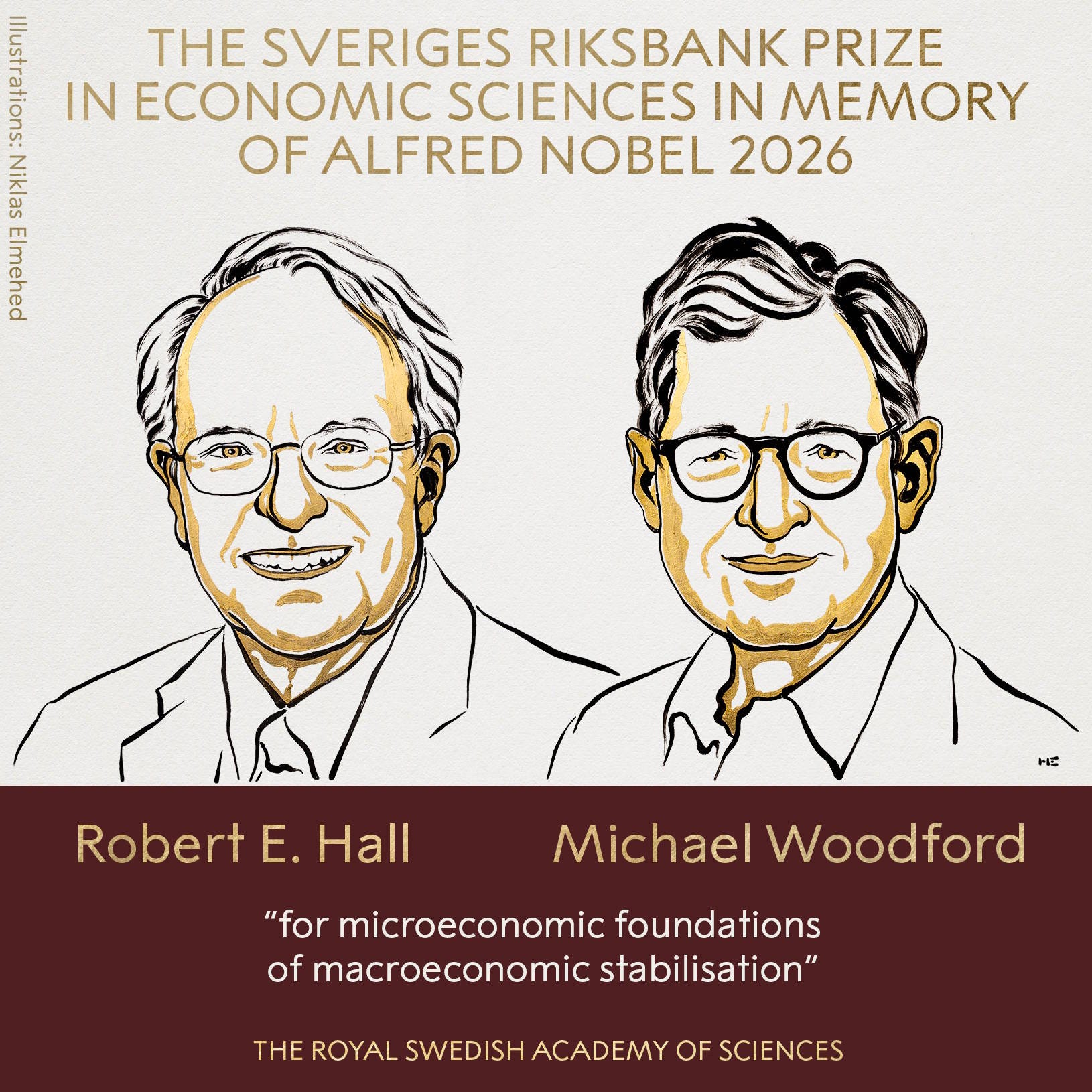
This year's Nobel Prize in Economics has been awarded to Bob Hall and Michael Woodford, two of the most influential creators of New Keynesian macroeconomics. The Nobel Committee has recognized their significant contributions to the field, acknowledging that this recognition was long overdue. In 2009, the author of this article, Miles Kimball, had asked his PhD advisor, Bob Hall, whom he believed to be the greatest living macroeconomist.
Hall confidently stated that he was not surprised if he did not win the Nobel Prize, as he had already made such a profound impact on the field.
New Keynesian macroeconomics is a theoretical framework that emerged in response to the limitations of earlier models. Back in the 1960s and early 1970s, most economists sought to understand the macroeconomy by analyzing relationships between macroeconomic aggregates. However, this approach failed to capture the complexities of economic behavior and was unable to predict policy outcomes accurately.
This led to a reexamination of macroeconomic models, with economists searching for a more robust foundation upon which to build their theories.
The concept of "microfoundations" became central to this quest. Instead of relying on aggregate data, macroeconomists began to build models based on the underlying behavior of individual consumers and businesses. At the heart of this approach was the idea of rational expectations, which posited that consumers and businesses should, on average, have the same level of economic knowledge as the economists modeling the system.
This insight was championed by Bob Hall in a pivotal 1978 paper, which demonstrated that random fluctuations in consumption could be attributed to the inherent unpredictability of economic variables. Hall's work laid the groundwork for the development and recognition of New Keynesian macroeconomics, a framework that has since become a cornerstone of modern economic theory.
Written by urgent.news from Noahpinion's reporting — not their text. Machine-written — may contain errors; check the original before relying on it.