(LEAD) BOK chief says back-to-back rate hikes bought time to respond to financial risks
SEOUL, Oct. 12 (Yonhap) -- The head of the Bank of Korea (BOK) said Monday the c...
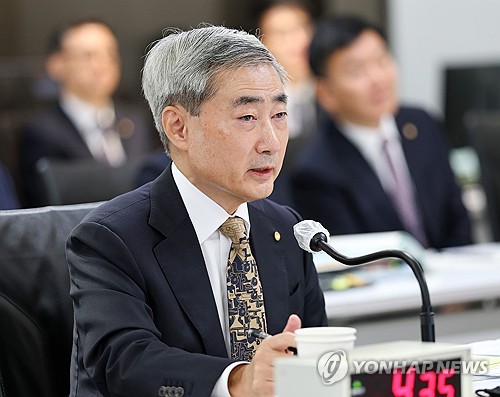
BOK Governor Shin Hyun-song has stated that the Bank of Korea's successive interest rate hikes have provided the central bank with the opportunity to address potential financial risks. The governor revealed that the BOK had increased the benchmark interest rate to 3% during two consecutive meetings in July and August, as a preemptive measure to curb inflationary pressures.
Following the August meeting, Shin emphasized the importance of addressing problems immediately, drawing a parallel to the proverb "To block something with a shovel that could have been blocked with a hand hoe." He added that the dual rate hikes were unprecedented and served as a strong signal to the market, enabling financial authorities to respond proactively and stave off more severe fluctuations.
Since the last two to three weeks, yields on Korean government bonds have remained relatively stable, according to Shin. While the central bank acknowledges that raising the benchmark interest rate may cause some hardship, it believes that preemptive action ultimately stabilizes the market and reduces overall costs. In addition to raising the benchmark rate, Shin mentioned that the Bank of Korea will strive to incorporate accurate data on overseas artificial intelligence (AI) service subscriptions into national statistics.
Although South Korea recorded a deficit of $6.4 billion in its intellectual property services account in the first half, the BOK's current account data does not provide a detailed breakdown of payments related to software copyrights. The central bank intends to improve its statistical methodology to better reflect current trends.
In a report submitted to the National Assembly, the BOK forecasted continued solid growth for the South Korean economy, attributing the robust performance to strong semiconductor exports. The domestic economy is expected to witness a significant uptick in growth this year, driven by strong semiconductor exports, and is projected to maintain steady growth in the subsequent year.
As the semiconductor sector continues to expand, the positive impact of improving income conditions is anticipated to permeate domestic demand, including consumer spending, resulting in a favorable growth trend. The BOK revised its growth forecast to 3.3% for 2026 and 2.9% for 2027, citing the ongoing semiconductor upcycle and its spill-over effects on the broader economy.
The central bank also highlighted that consumer prices are projected to stay above the 2% target due to strong exports and investments bolstering household incomes. Specifically, core inflation, which excludes volatile energy and food prices, has risen to nearly 3% in recent months, primarily attributable to supply chain disruptions stemming from the prolonged Middle East crisis.
The BOK emphasized the need to closely monitor inflation, economic trends, and financial stability, and determine the appropriate timing and pace of further interest rate hikes. The next rate-setting meeting of the BOK is scheduled for October 22.
Written by urgent.news from Yonhap News's reporting — not their text. Machine-written — may contain errors; check the original before relying on it.