Governing Context at Scale: Security, Observability, and Multi-Agent AI
Govern context for enterprise AI at scale: treat context as a product, secure it, make it observable, and coordinate multi-agent systems, with AWS examples.
Part 3: Observing Context and Governing Multi-Agent Systems
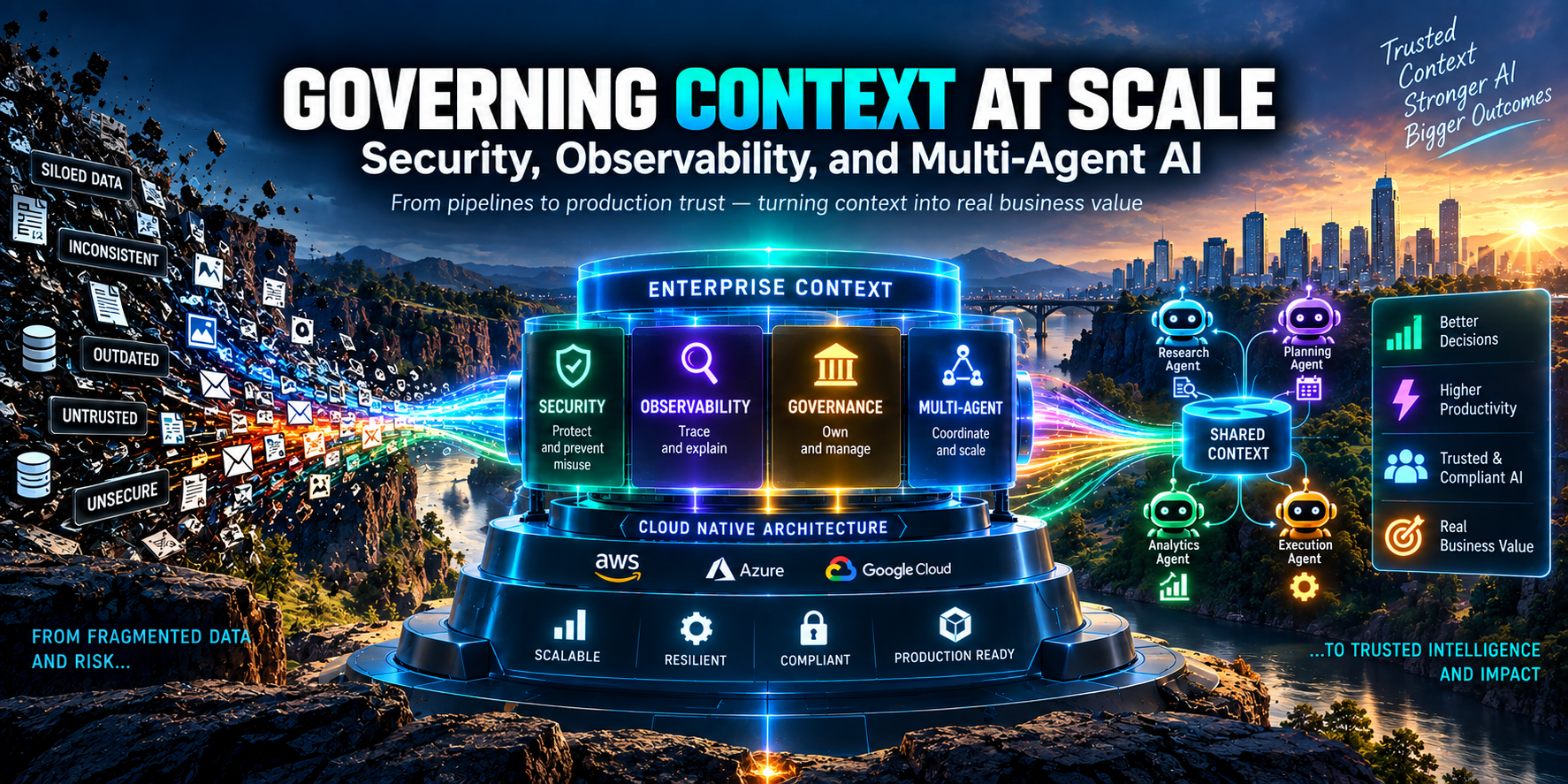
Observability is crucial for running context at scale. When context becomes the foundation for enterprise decisions, it's no longer enough to simply have a pipeline that produces reliable answers. We need mechanisms to understand how the context is being used, how trustworthy it is, and how to manage potential conflicts between different sources of information.
The logistics assistant we've been using as an example provides a useful case study. During testing with a few hundred shipment queries, we saw that as many as 1 in 6 responses had discrepancies in estimated arrival times across the transportation management system (TMS), carrier APIs, and older operational reports. All three sources were technically valid, but none of them agreed on the same point in time. This highlights the need for context observability.
By tracing the sources, retrieval process, and confidence levels behind each AI decision, we can gain visibility into how the context is being used. This allows us to identify and flag any conflicts or anomalies, rather than silently picking an answer based on which source happened to surface first. With clear observability, the AI system can provide more transparent and accountable outputs.
Another key aspect is governance, particularly when multiple AI agents are working with shared knowledge. Multi-agent systems depend on coordinated access to the same context, without duplicating effort or creating inconsistencies. To enable this, we need clear governance policies that define who owns the knowledge, who can approve updates, how frequently the knowledge should be refreshed, and how conflicts should be resolved.
In the logistics assistant example, source ownership is critical. The TMS might be the authoritative source for internal shipment status, while the carrier API carries the latest carrier-reported estimate. Older reports shouldn't automatically take precedence just because their wording matches the user's question more closely. By assigning clear ownership and recording update timestamps, we can make better decisions about which source to trust for each type of data.
Governance also needs to address security concerns. During testing of 120 queries that combined shipment and contract data, the assistant inadvertently retrieved a customer contract alongside shipment information, including pricing terms that the requesting user should not have seen. This illustrates the need for least-privilege access, context poisoning defenses, prompt injection protections, and sensitive data controls throughout the retrieval and assembly process.
By implementing these security measures, we can prevent unauthorized access to sensitive information and ensure that the AI system only receives what is permitted for each user or component.
In summary, running context responsibly at scale involves treating it as a product with proper versioning, curating and governing the knowledge base, applying secure engineering practices to protect against exposure and manipulation, observing usage to maintain observability, and establishing clear governance structures for multi-agent systems. By applying these principles, organizations can build AI systems that are more reliable, accountable, and trustworthy for enterprise decision-making.
Rewritten by urgent.news; may contain errors — check the original.
Source: hackernoon.com