Astronomers witness supermassive black hole gorge on a cosmic meal before 'burping' radio jets 300 days later
Using the NASA spacecraft Swift, astronomers observed a supermassive black hole burping radio jets 300 days after a heavy cosmic meal.
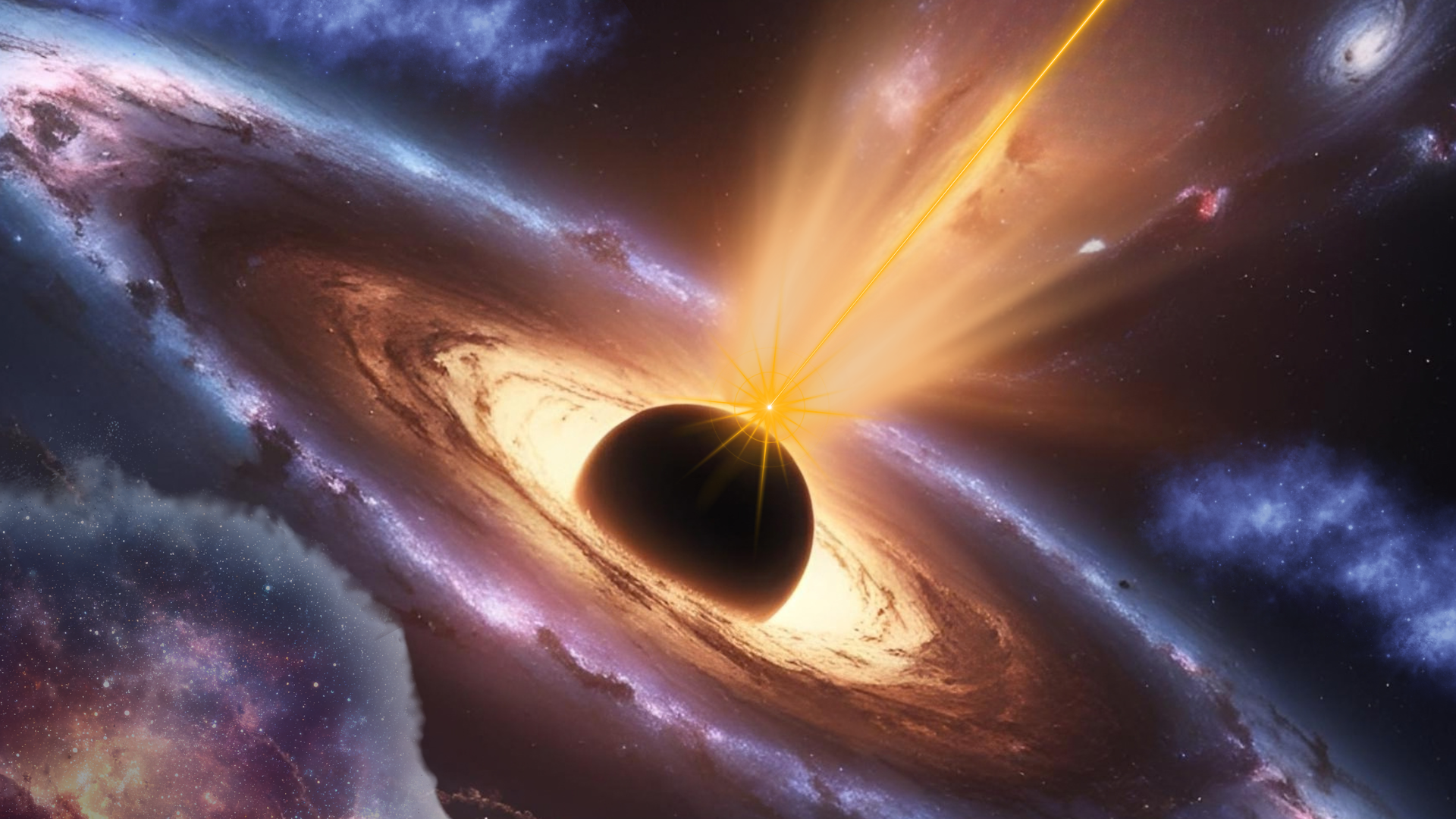
Using NASA's Swift spacecraft and radio observations, astronomers have witnessed a supermassive black hole consuming a significant amount of cosmic material before emitting radio jets 300 days later. The black hole resides at the core of the Perseus Cluster, containing thousands of galaxies, and is situated at the heart of the galaxy NGC 1275, approximately 225 light-years away.
The black hole is the brightest galaxy within the Perseus Cluster. Initially detected in X-rays, the black hole's increased matter accretion rate indicated an impending cosmic feast. Active supermassive black holes, located within active galactic nuclei (AGNs), generate immense gravitational forces that heat surrounding matter, causing it to glow brightly.
These emissions are reinforced by material channeled to the poles of the central black hole, resulting in powerful twin jets that radiate across the electromagnetic spectrum, particularly in radio waves. This observation of radio jets following an X-ray flare is crucial for understanding the connection between the accretion disk surrounding the black hole and the jets it generates.
This relationship, known as disk-jet coupling, is essential for comprehending how black holes impact star formation within galaxies and contribute to their growth. To observe this phenomenon, NASA's Neil Gehrels Swift Observatory, while lacking Chandra's X-ray observing capabilities, has amassed extensive data on NGC 1275 since its launch in 2004.
The inner region of this AGN is challenging to observe due to the intense light emitted by the galaxies in the Perseus Cluster. By developing a model to eliminate the cluster emission from Swift's archival data, astronomers successfully identified changes in X-ray flux from matter accreting onto the black hole between 2007 and 2025.
The capabilities of Swift were instrumental in this investigation, revealing NGC 1275 as the ideal laboratory for studying disk-jet coupling. The team observed the most powerful X-ray flare from NGC 1275 in February 2023, lasting less than 60 days and consisting of two 5-day bursts, causing a doubling of the AGN's X-ray brightness.
This flaring event, lasting only 60 days, was likely due to a spike in the rate of matter accretion onto the black hole, not a tidal disruption event (TDE). The team constrained the mass of the black hole at the heart of NGC 1275 to be between 100 million and 1 billion times the mass of the sun. Comparing their data with known radio data, they identified a potential 300-day delay between the X-ray flares and the radio wave emission, indicating the time required for plasma to travel from the base of the jet to a shock created when it encounters surrounding gas or dust.
Further observations using XMM-Newton and XRISM are necessary to establish this connection definitively.
Written by urgent.news from Space.com's reporting — not their text. Machine-written — may contain errors; check the original before relying on it.