UAE turns to AI to fight fires: Find out how it will save residents, firefighters and protect properties
Dubai: The UAE is turning to artificial intelligence (AI) to make firefighting and disaster response faster and safter, helping save lives and protect property, according to two top officials. At the heart of the push is agentic AI, a form of AI that can act with a degree of independence. Major General Dr Jassim Mohammed Al Marzooqi, Director General of the Federal Authority for Ambulance and…
The United Arab Emirates is harnessing the power of artificial intelligence (AI) to enhance firefighting and disaster response efforts, aiming to save lives and safeguard properties, according to two top officials. The Federal Authority for Ambulance and Civil Defence is integrating agentic AI, a form of AI capable of acting independently, into its operations to improve protection and response.
The new technology is expected to reduce the frequency of fires, minimize casualties, and safeguard residents and firefighting personnel. AI ambassadors will be appointed in each civil defence directorate across the UAE, tasked with identifying and sharing best practices on the use of agentic AI to enhance services.
The technology can map high-risk areas and forecast accidents before they occur, enabling teams to be prepared for potential incidents. Rather than replacing firefighters, AI will support them by providing more advanced equipment, technology, and AI to carry out their tasks more efficiently while minimizing risks to their safety.
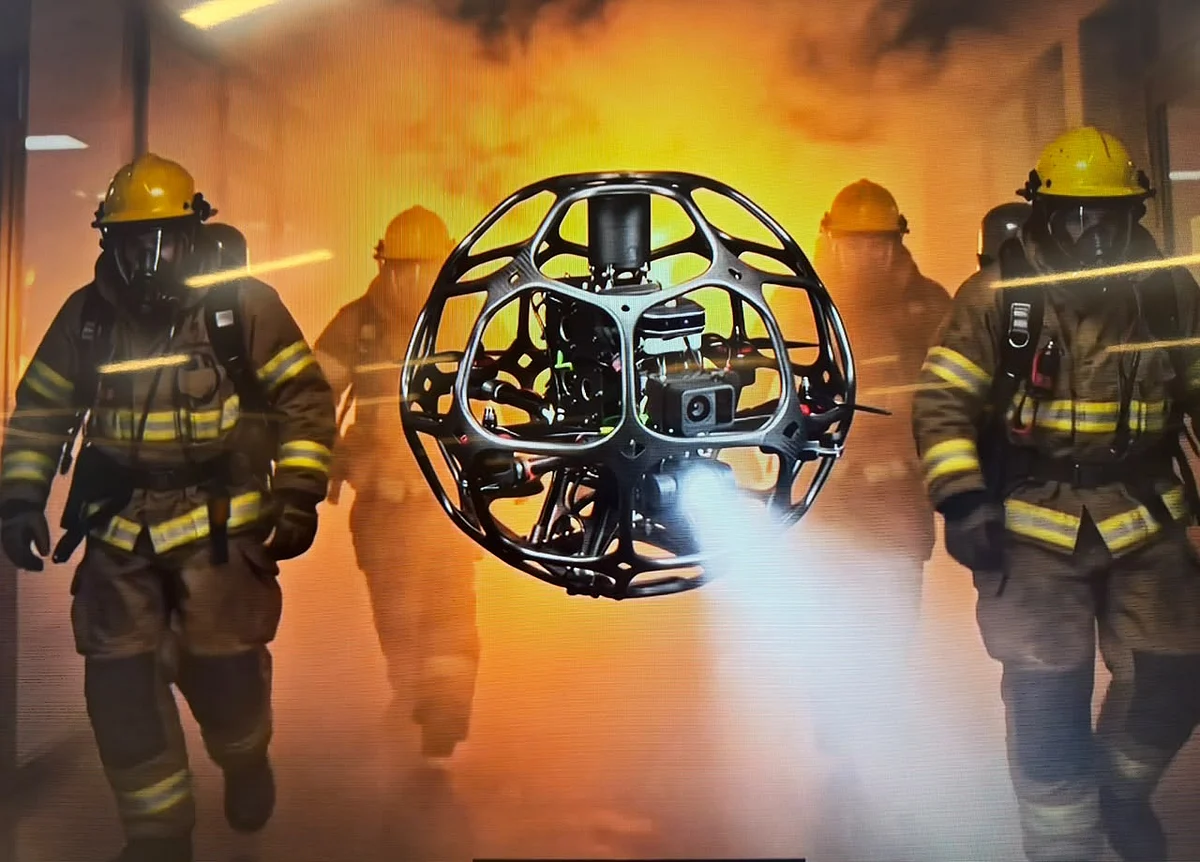
Several projects were showcased at a specialized forum, highlighting the potential of AI in firefighting. For instance, Kashif, a high-tech drone developed by Dubai Civil Defence and Dubai AI Campus, is designed to operate inside burning buildings. The drone navigates without GPS, withstands extreme temperatures, and locates trapped individuals using millimetre-wave radar, which also monitors their vital signs.
The data is transmitted in real-time to Dubai Civil Defence, enabling firefighters to identify the safest route and reach trapped occupants more quickly.
Another project, Najda, is a wrist-worn device that monitors firefighters' vital signs continuously, setting a personalized baseline for each individual and flagging abnormal readings. If a critical change occurs, the device sends an SOS alert to the team leader. This wearable device can operate without an internet connection, displaying alerts on a screen inside the fire truck and sending data to headquarters when connectivity is available.
Lastly, Athar is a search-and-rescue system aimed at the first 72 hours following a building collapse, earthquake, or similar emergency. It employs small drones and hand-sized rovers to locate trapped people and gather information from hazardous or inaccessible areas. The AI-enabled system features a self-forming communication network, allowing each drone or rover to act as a relay when connectivity is weak and enabling operation without GPS, Wi-Fi, or existing communications infrastructure.
Written by urgent.news from Gulf News's reporting — not their text. Machine-written — may contain errors; check the original before relying on it.