The imagined Palestinian landscapes of Jordan Nassar's tatreez panels
The Palestinian poet Mahmoud Darwish once dedicated a poem to the frustration he felt at his inability to describe a cloud. Staring up at the sky while walking alone on an unnamed mountain, he wrote that the clouds were “like a cottoned ginned by wind, like a white idea about the meaning of existence”. That poem – and presumably Darwish’ failing words – guides a new series of contemporary…
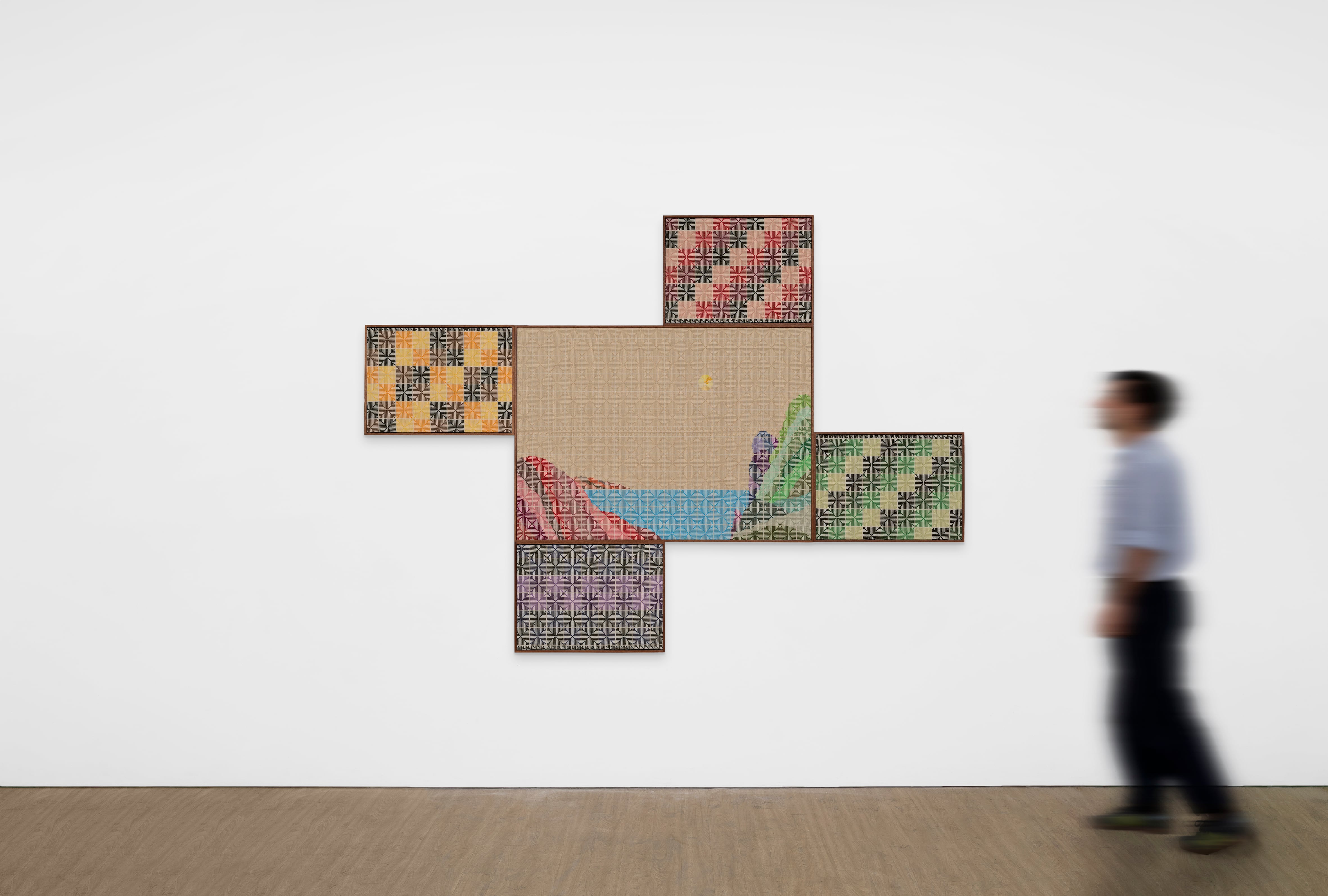
Jordan Nassar, a Manhattan-born artist, has created a new series of contemporary artworks using Palestinian cross-stitch embroidery called tatreez. The exhibition, titled "The Imagined Palestinian Landscapes of Jordan Nassar's Tatreez Panels," is currently on display at No 9 Cork Street in London, marking the artist's first UK showing in over a decade.
Nassar's work, titled "They Build Homes with Clouds" (2026), features green, red, and purple-hued mountains against an ochre sky, with embroidered squares surrounding them. The artist describes these landscapes as "versions of Palestine as they exist in the minds of the diaspora," representing the fantastical and colorful dreamlands of his childhood memories. Some of the panels appear to be drawn from American road movies, featuring arid scenes reminiscent of the Mojave or Sonoran deserts.
The artist's exploration of Palestinian identity is rooted in his own upbringing in New York, where his father is of Palestinian heritage and his mother is Polish. Growing up in the 1990s, Nassar was surrounded by multiculturalism, but as he grew older, he noticed the challenges of belonging to a diaspora community. His paternal grandfather, who migrated to the US in the 1910s, played a significant role in establishing the Arab American community in Yonkers, sponsoring the arrival of hundreds of families displaced by the Nakba.
Nassar's work engages with the challenges of Israel's occupation, even if he does not make it explicit. He designs the panels and commissions the embroideries from craftswomen living in the West Bank. The process is complex, with the finished works being transported from the West Bank to the US via a series of international mail routes.
Despite the logistical challenges, Nassar's work reflects on archaeology and the politics of cultural heritage in conflict, with a series of hand-cut glass mosaics inspired by Byzantine churches in Gaza.
Written by urgent.news from The National Business's reporting — not their text. Machine-written — may contain errors; check the original before relying on it.
This story
This is one outlet's version. Read the fullest account.
- The imagined Palestinian landscapes of Jordan Nassar's tatreez panels thenationalnews.com