Google LSA's October Update Creates a New Lead Attribution Problem
Google’s October 2026 LSA update changes how missed calls, follow-ups, IVR interactions, and bookings become billable leads.
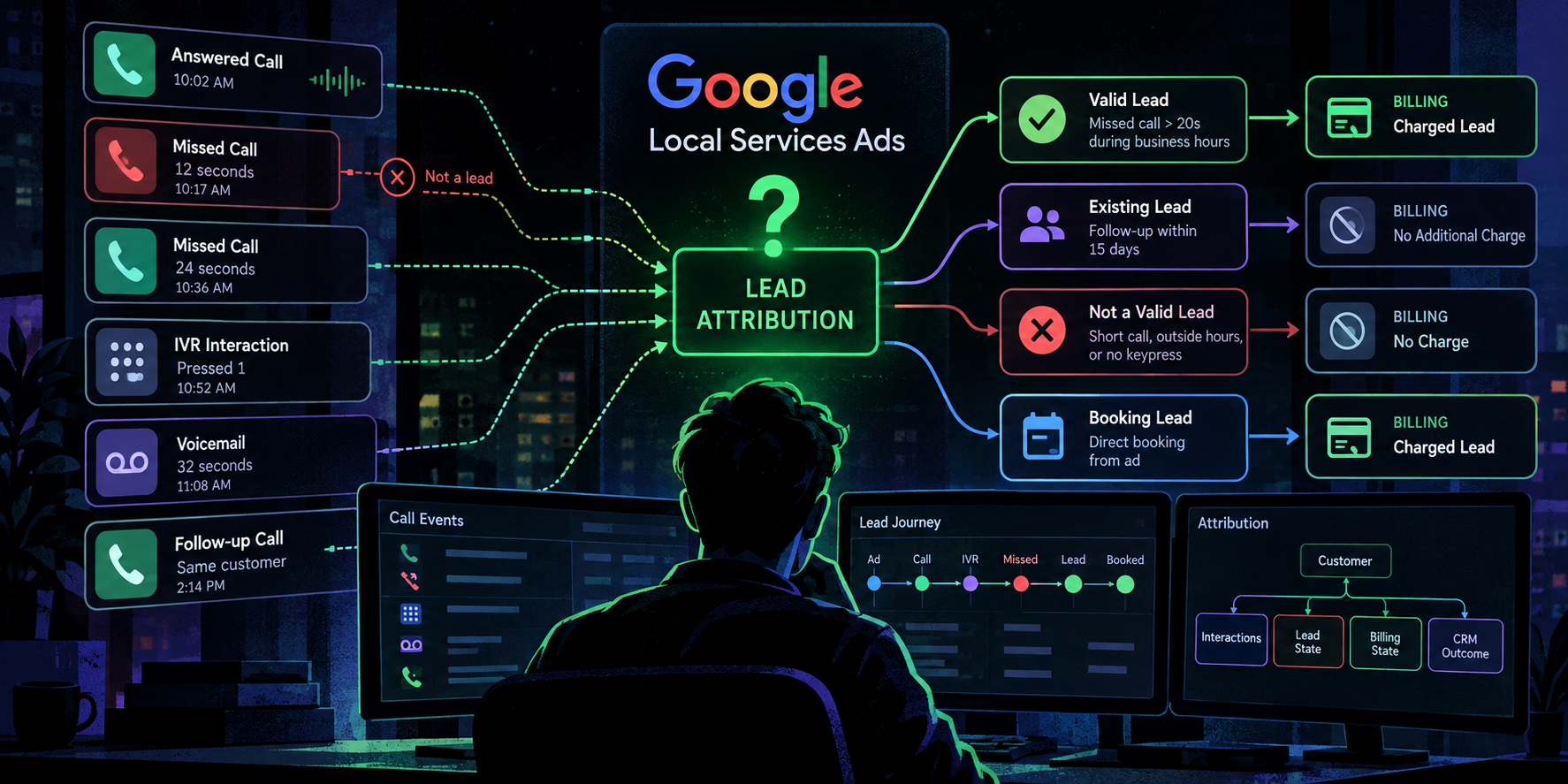
Google's October 2026 update to Local Services Ads (LSA) introduces new complications for tracking and attributing customer interactions to billable leads. The update changes the criteria for when certain missed calls and subsequent calls become chargeable, based on factors such as call duration, voicemail, IVR interactions, and follow-up messages.
The obvious question is how many more calls businesses will be charged for. However, the more significant issue is determining which customer interactions actually create the billable leads. This attribution problem becomes even more complex when a single customer can generate multiple calls before Google establishes the lead status.
A basic LSA reporting model may track call ID, customer, timestamp, campaign, cost, and lead status. But this model becomes less useful when the question shifts from "How many calls did the campaign generate?" to "Which interaction caused Google to classify this customer as a billable lead?"
Consider a plumbing company. A customer may call twice, with the first call not meeting Google's 20-second missed-call condition and the second call potentially creating a billable lead. The distinction between the interaction that created the lead and the one that did not is crucial for attribution, billing reconciliation, and campaign optimization.
Google's documentation indicates that once a lead is charged, subsequent calls or messages from the same customer within 15 days, using the same phone number or email address, are not charged again. After 15 days of inactivity, a new interaction can create a new lead if it meets the valid-lead criteria. This introduces a relationship between events, where a call is an event, a lead is a state associated with one or more events, and a charge is an outcome of that state.
The October change adds temporal conditions to this model, such as the 20-second rule for unanswered calls during business hours. A reporting system must distinguish between events that create leads and those that do not. Factors such as IVR interactions, voicemail, and different customer identifiers further complicate the attribution process.
Google's treatment of automated phone systems, such as IVR menus, introduces additional complexity. If a caller never presses a key on an IVR, the missed-call charging condition does not apply. However, Google's lead model may treat such calls differently from a simple "missed call" classification. A CRM may only recognize certain interactions as actionable leads, while Google's lead system can treat multiple interactions differently.
The problem becomes more pronounced when the same customer contacts the business through different identifiers. A CRM may recognize multiple interactions as a single customer, while Google's 15-day follow-up treatment relies on the same phone number or email address. This discrepancy between systems creates a data-integration challenge, as call-tracking platforms, Google's lead model, and the CRM all describe the same event using different levels of abstraction.
To accurately track and attribute customer interactions to billable leads, agencies must develop a comprehensive reporting system that captures the necessary context and integrates data from various sources. This includes distinguishing between missed calls, answered calls, IVR interactions, voicemail, and follow-up messages, as well as handling customers with multiple identifiers.
By providing enough context to explain the state transition from call to lead to charge, agencies can optimize their campaigns and ensure accurate billing.
Rewritten by urgent.news; may contain errors — check the original.
Source: hackernoon.com