Residents bat for public transport over elevated corridor in south Bengaluru
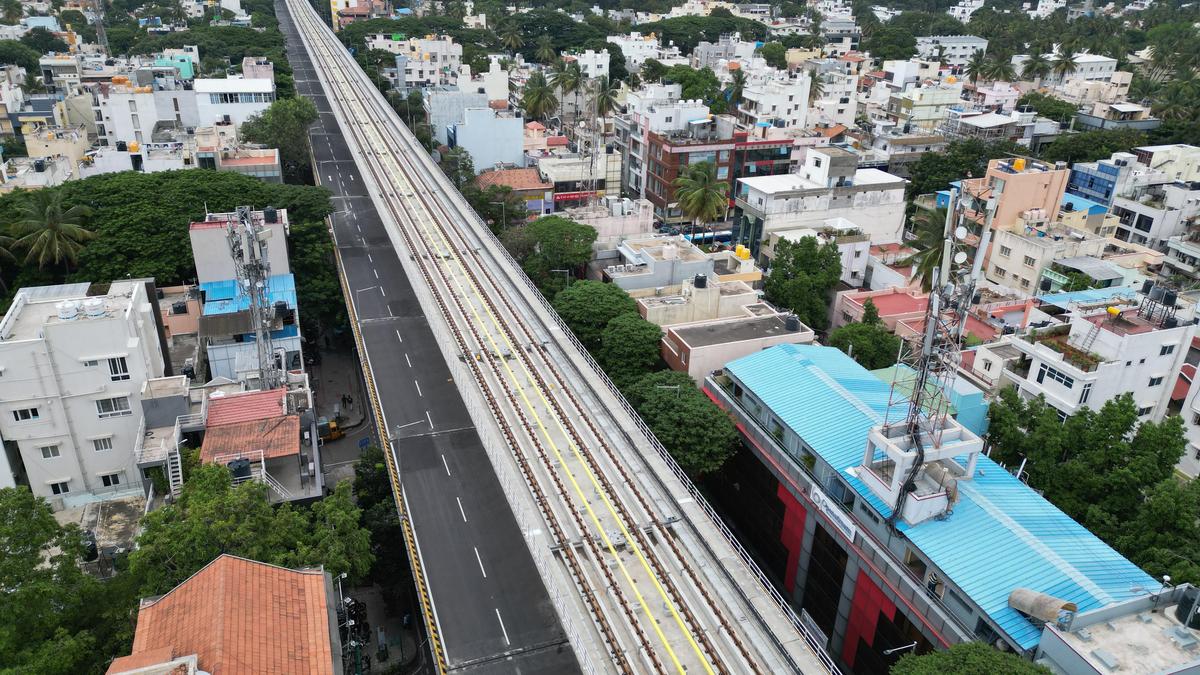
Members of local residents' groups in Jayanagar and neighboring regions are opposing the proposed 18.5-kilometer elevated corridor in south Bengaluru, operated by Bengaluru Smart Infrastructure Limited (B-SMILE). The corridor, slated to run from Ragigudda Junction to Kanakapura Road, would be toll-based. Nearly three residents' associations have organized a protest, planning a human chain near the proposed route on Sunday to raise awareness about the project's potential impact on citizens.
This opposition comes after residents of Indiranagar, C.V. Raman Nagar, and HAL voiced strong resistance against another elevated corridor between Old Madras Road and Silk Board Junction. Similar groups in eastern Bengaluru have also been opposing the project, with one conducting an independent, citizen-led survey of trees to assess the impact on green spaces.
In August, B-SMILE issued tenders for the Ragigudda corridor, prompting residents to seek input from traffic and transport experts and review the Detailed Project Report (DPR). Guruprasad D.N., a group organizer, emphasized that there is already metro connectivity along the planned alignment, and the project's main need is to improve first- and last-mile connectivity.
The group also raised concerns about the corridor's path, which passes through Rose Garden and Pipeline Road, both rich in green spaces. Additionally, the project requires forest land near NICE Road, with 16,445 sq. m of government land and 13,481 sq. m of private land needed. Private land requirements cover 24 properties, with the corridor passing within a few feet of private properties, potentially causing inconvenience to several households.
B.S. Prahallad, B-SMILE's Technical Director, defended the project, citing the year-on-year traffic growth highlighted in the DPR. He acknowledged the inconvenience to local residents during acquisition and construction but stressed that many commuters will benefit from the corridor in the long term. The DPR notes that traffic capacity at most junctions along the proposed corridor has exceeded its design capacity of 10,000 Passenger Car Units (PCUs) per hour, necessitating immediate intervention to avoid future bottlenecks.
Most of the PCU growth is projected to occur at seven junctions, with the Rose Garden junction alone seeing a rise from 6,169 PCUs in 2025 to 11,599 PCUs by 2035. However, the DPR also presents two alternatives to address the growing demand: policy changes, a shift in transportation modes, and promoting public transport.
Rewritten by urgent.news; may contain errors — check the original.
Source: thehindu.com