Regierungsbildung: MV auf Kurs Rot-Rot-Grün - Verhandlungsstart am Montag
SPD, Linke und Grüne wollen in MV über eine Koalition verhandeln. Dafür stimmten alle drei Parteien. Für die Grünen wäre eine Regierungsbeteiligung in MV eine Premiere.
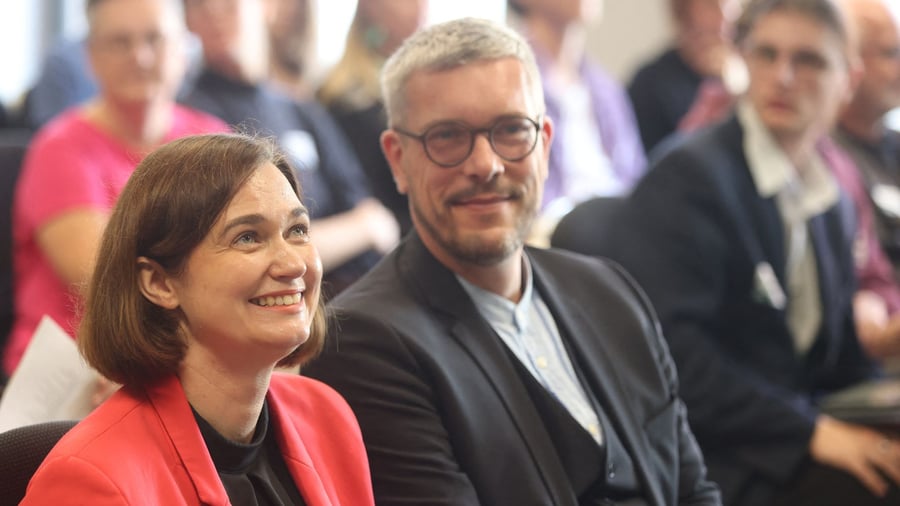
The stage is set for a Rot-Red-Green government in Mecklenburg-Western Pomerania, as the Social Democrats (SPD), the Left Party (Linken) and the Greens have agreed to commence coalition negotiations for the first tripartite alliance in the state's history. The negotiations are scheduled to begin on Monday. The negotiators, led by SPD State Secretary and Minister-President Manuela Schwesig, Linken State Secretary Hennis Herbst and Green State Secretary Claudia Müller, are set to hold a joint press statement at 14:00 on Monday.
Post Minister positions are to be discussed at the very end, said Schwesig, who expressed satisfaction with the sondiering in recent weeks: "The talks were very good." Linken's Herbst emphasized during the Green Party's small party conference in Rostock that all three potential coalition partners were very clear on the issue of far-right extremism.
This is currently the greatest threat to democracy in Mecklenburg-Western Pomerania. "Therefore, there will be no cooperation with the AfD," said Müller. Looking ahead to the green priorities in the negotiations, she stressed the need for sustainable energy to be implemented in a socially just manner. With the state election on September 20th, the AfD has become the strongest party with 32 seats, but it does not have a majority in the Schwerin State Parliament with its 71 members.
Together, the SPD (29), Greens (5) and Linken (5) have more than half of the seats. If the government formation goes smoothly, they will have three more seats than needed for a majority. "More than a tripartite alliance" The three parties have big plans. "We want to be more than a tripartite alliance," said Schwesig on Friday evening.
"We want to be there for everyone: in the city and in rural areas, for young and old, for our voters and for those who are skeptical or did not vote for us." Linken State Secretary Herbst pointed to a planned increase in civic participation in the state, such as citizen councils. During the sondiering, the parties reportedly agreed on central projects for the next five years.
"Under the MV plan, an additional 1.9 billion euros from the special fund will flow into the modernization of the state by 2035," the negotiators said. "The kindergarten will remain fee-free, schools will be further modernized and teaching provision improved." The partners also want to fight for the preservation of all hospital locations and create 1,000 new or renovated apprenticeship and study accommodation places.
These include a discounted youth ticket for public transport, more civic participation and a parliamentary investigative committee on far-right networks, as demanded by the Linken. The seven working groups for the coalition negotiations will work on individual topics: finance and digitalization, agriculture and climate protection, economy and energy, education and culture, social and health care, interior and municipalities as well as special issues (federal and Europe).
Seven working groups will work on the individual topics of the coalition negotiations: finance and digitalization, agriculture and climate protection, economy and energy, education and culture, social and health care, interior and municipalities, and special issues (federal and Europe). The coalition negotiations are to be led by a main group of top representatives from the three parties.
Seven working groups will work on the individual topics. The state parliament of all three parties will decide on the coalition agreement and the formation of the new state government at their party congresses. The legislature selects the Minister-President at the latest by November 17th. Much time is needed to forge the tripartite alliance.
The state parliament convenes for its constituting session on October 20th. After that, the constitution gives the legislature four weeks to elect the Minister-President or the Minister-President. At the latest, this would be November 17th. It is clear that they are seeking another term in office, as the SPD politician Schwesig has never had any doubts.
Written by urgent.news from Handelsblatt's reporting — not their text. Machine-written — may contain errors; check the original before relying on it.