Northern Lights stun UK down to England's south coast
The natural phenomenon, known as the Aurora Borealis, is the result of increased solar activity.
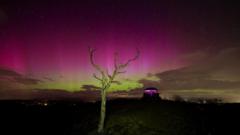
Residents across the UK were left in awe as the night sky was illuminated by the vibrant colors of the Northern Lights on Friday and Saturday evenings. Known as the Aurora Borealis, this natural phenomenon is triggered by heightened solar activity. While typically visible near the Arctic Circle and northern Scotland, exceptionally strong activity levels allowed the lights to be witnessed as far south as Devon, Hampshire, and Kent on Saturday night.
The Met Office predicts sightings could persist under clear skies until Tuesday. Aurora Borealis are generated by powerful solar eruptions from the Sun, known as coronal mass ejections (CMEs). During the previous week, the Sun released CMEs directed towards Earth. These charged particles, once captured by Earth's magnetic field, are channeled into our atmosphere, particularly in polar regions. The collision of these particles with oxygen and nitrogen emits photons of colored light, creating the aurora effect.
Sightability of the aurora varies across the UK based on its strength. A level of 200nT (nanotesla) would typically permit viewing in the northern parts of the UK, but not the southern regions. However, on Saturday evening, levels surged to 600nT, enabling visibility across the entire UK, including southern areas, which is an uncommon occurrence. Experts have indicated that 2026 will be a peak year for aurora-spotting, as the Sun is currently in a heightened state of activity due to its 11-year natural cycle.
Written by urgent.news from BBC News's reporting — not their text. Machine-written — may contain errors; check the original before relying on it.