Knowledge Nugget | Can the promise of IMEC become a reality?
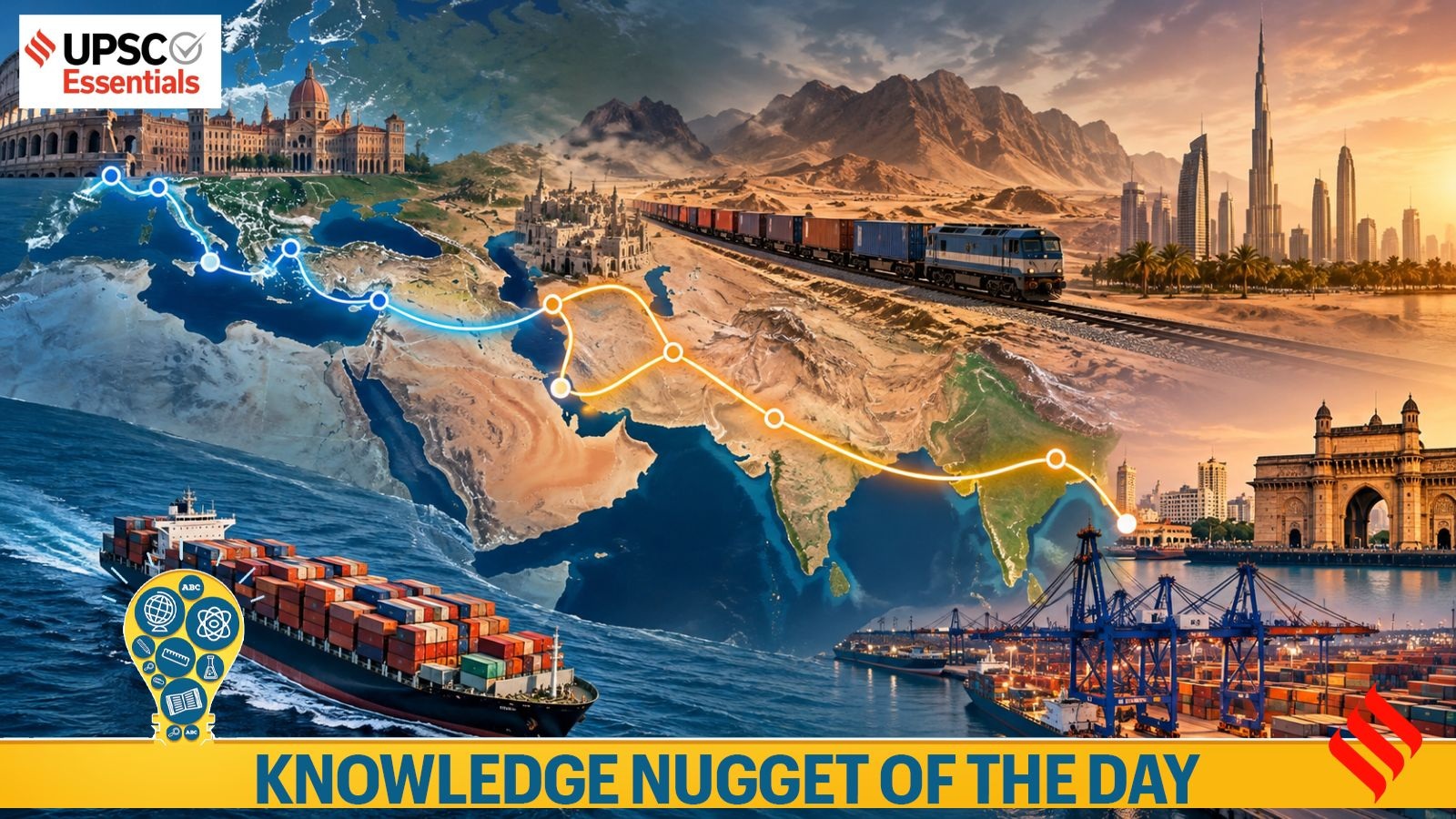
The India-Middle East-Europe Economic Corridor (IMEC) is a significant initiative aimed at improving connectivity and economic integration between Asia, the Middle East, and Europe. As tensions in West Asia persist, there is growing recognition of the need for resilient trade routes. Countries like Oman, Egypt, Lebanon, Greece, and Cyprus have shown interest in participating in the project.
IMEC is a landmark project that was launched at the G20 Leaders’ event in New Delhi in 2023. It seeks to develop a seamless network of ports, railways, roads, sea lines, and pipelines to enhance trade between India, the Arabian Peninsula, the Mediterranean region, and Europe. The corridor consists of two parts: the east corridor connecting India to the Arabian Gulf and the northern corridor linking the Arabian Gulf to Europe, along with a railway route to boost trade exchanges among India, the UAE, Saudi Arabia, Jordan, Israel, and Europe.
By providing a reliable, cost-effective railway and ship-to-rail transit network, IMEC aims to reduce shipping time from India to Europe by approximately 40% compared to the existing Red Sea route. This would save around three to four days of transit, making it a game-changer in terms of shorter transits, accessibility, and multimodal connectivity.
However, progress has been limited since the project's announcement. The ongoing conflict in Gaza and regional hostilities have disrupted the land transit route that passes through Jordan and Israel, posing a significant threat to the project's physical continuity. Additionally, strained relations between Jordan and Israel due to the American push for Jordan to absorb more territory further complicate the implementation of IMEC.
Despite these challenges, the corridor holds immense potential to revitalise economic progress across the region and reduce shipping times by nearly half, providing a much-needed alternative to the congested Suez Canal and Mediterranean shipping routes.
Written by urgent.news from The Indian Express's reporting — not their text. Machine-written — may contain errors; check the original before relying on it.