How South Korea is reshaping its role in global trade
In June 2026, South Korea achieved what would have seemed unimaginable a decade ago: monthly exports surpassed USD 100 billion for the first time, rising 70.9% year-on-year. This s...
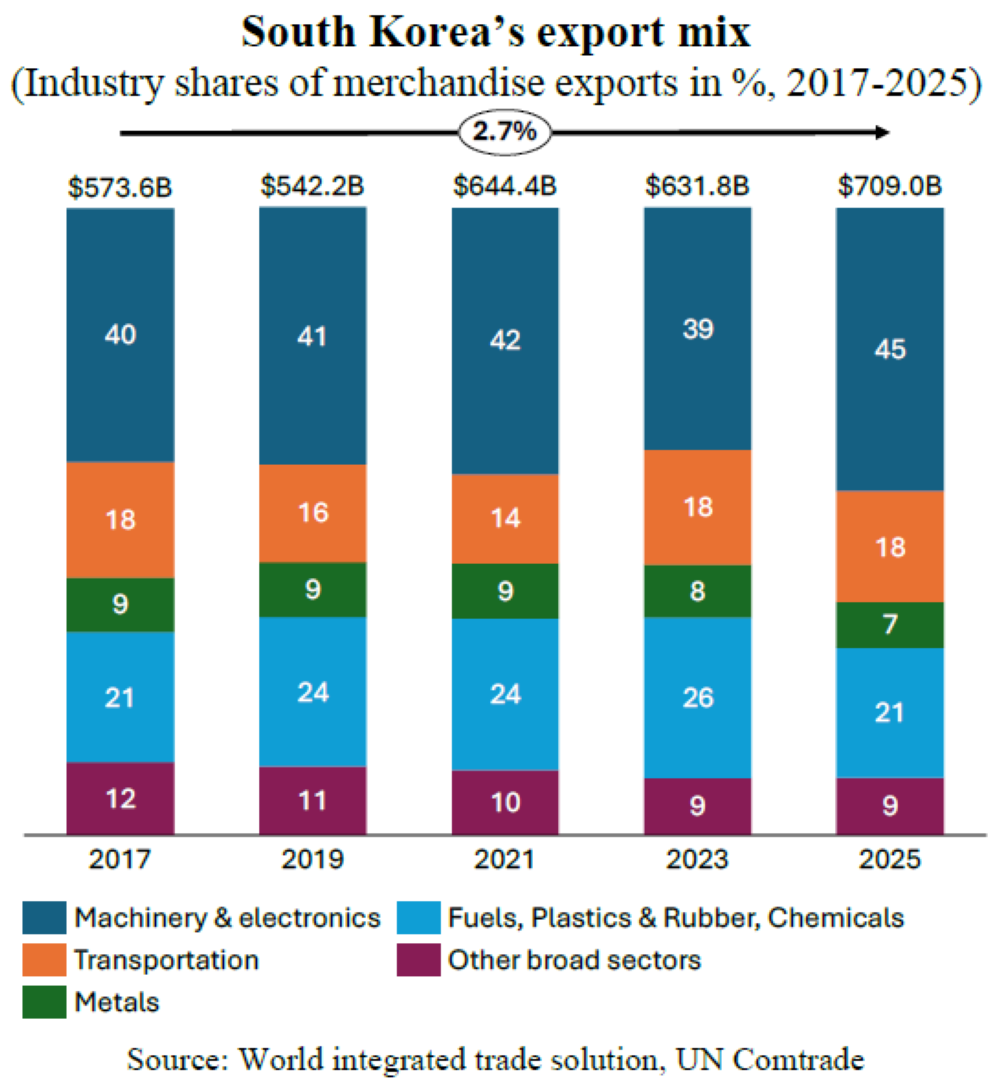
In June 2026, South Korea made history by achieving monthly exports exceeding $100 billion for the first time, a 70.9% increase from the previous year. This growth was fueled by semiconductors and Solid-State Drives (SSD), which made up over 80% of information and communications technology (ICT) exports. ICT alone surpassed half of South Korea's total exports for the first time in its history.
By 2025, total exports reached a record $709.7 billion, with the largest trade surplus since 2017, largely due to the high demand for AI memory chips, a specialty South Korea can produce at scale.
Despite these impressive figures, South Korea's export success story is facing new challenges. Open global trade, a changing relationship with China, and the country's dominance in memory chips are all under pressure as global trade becomes more decentralized. South Korea now stands at a crossroads, with a choice to either remain an export nation reliant on chip volumes and market access, or transform into a global supplier shaping critical industries' supply chains, particularly in AI and technology.
South Korea's success in the memory chip industry is primarily attributed to Samsung Electronics and SK Hynix, which control about 73% of the global market for high-speed memory chips. As major tech companies worldwide invest in AI infrastructure, the demand for South Korean chips has surged exponentially. However, this concentration of success presents risks, as the global trade landscape becomes increasingly unpredictable.
Additionally, China, South Korea's largest export market for decades, is now developing domestic alternatives for many South Korean products, including electronics, electric vehicles, and batteries. This has led to a sharp decrease in South Korea's annual trade surplus with China, dropping from nearly $100 billion in 2018 to $20 billion in 2025.
In response to these changes, South Korea has strengthened its strategic partnership with the United States, culminating in a landmark trade and security agreement. The agreement reduces American tariffs on South Korean goods from 25% to 15%, providing relief for exporters. In return, South Korea commits to investing $350 billion in the United States, including $150 billion in the shipbuilding industry, the largest investment commitment in South Korean history.
Furthermore, the agreement grants South Korea the right to build nuclear-powered submarines, a capability previously pursued for security reasons. This partnership solidifies South Korea's position within the American-led industrial and security ecosystem, demonstrating a strategic shift away from China.
However, this partnership comes with costs. The $350 billion investment expectation requires significant capital from an economy that also needs resources for its own domestic technology development. Additionally, despite the deal, the United States initiated a trade investigation into South Korean manufacturing practices in March 2026.
Looking beyond its relationship with the United States, South Korea is actively diversifying its trade portfolio. Southeast Asia has emerged as a promising new market, with exports to the region growing at a rapid pace of 7.4% in 2025. South Korea aims to reach $150 billion in bilateral trade with Vietnam alone by 2030. Korean firms have established extensive manufacturing operations in the region, integrating into local supply chains for electronics, vehicles, and consumer goods.
In parallel, South Korea has quietly developed a burgeoning export industry in defense. The country's weapons manufacturers have capitalized on high-demand products such as armor, artillery, air defense systems, and rocketry, generating tens of billions of dollars in new export revenues. South Korean defense companies are now among the leading bidders for several critical defense contracts worldwide.
The naval shipbuilding industry in South Korea has gained international recognition as one of the most capable. This diversification opens up new revenue streams that were not anticipated a decade ago.
In summary, South Korea's 2026 trade story reflects remarkable adaptability. Record export volumes, unmatched semiconductor dominance, and a significant trade and security agreement with the United States highlight a nation that transforms challenges into opportunities. By shifting away from China dependence, South Korea is forging new and diverse trade relationships in Southeast Asia and other regions.
Its emergence as a world-class defense exporter has created an entirely new revenue stream previously unimagined. As South Korea enters the next phase of global trade, it positions itself not as a passive participant, but as an active architect of new partnerships, industries, and alliances, supplying the world with critical technology at scale.
Written by urgent.news from Qatar Tribune Business's reporting — not their text. Machine-written — may contain errors; check the original before relying on it.