Food basket gap leaves South African households choosing cost over nutrition
A September food basket comparison shows that a nutritious diet for a family of seven costs R1 167 more than the average household food basket, increasing pressure on families to prioritise affordability over dietary variety.
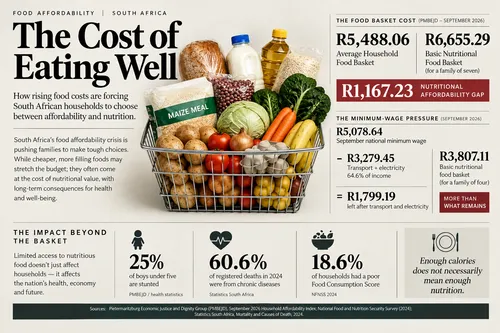
South Africa's escalating food affordability crisis is compelling families to prioritize cost over quality when making purchasing decisions. According to the Pietermaritzburg Economic Justice and Dignity Group's September Household Affordability Index, the average Household Food Basket costs R5 488.06, while the Basic Nutritional Food Basket for a family of seven amounts to R6 655.29, a difference of R1 167.23.
Mervyn Abrahams, a representative of the group, noted that the strain on household budgets forces consumers to buy less food and lower-quality products, often making more discerning choices. Transport and electricity expenses consume 64.6% of the September minimum wage, leaving a meager R1 799.19, insufficient to cover the basic nutritional food basket required for a family of four.
Health statistics reveal the dire consequences of inadequate nutrition, with South Africa experiencing high stunting rates among children under five, a significant proportion of diabetes cases, and a general rise in non-communicable diseases. Dr Heinrich Volmink of Physicians Association for Nutrition South Africa emphasized that affordable food does not guarantee nutritional adequacy, as it may still lack essential nutrients like dietary fiber, vitamins, and minerals.
Regular consumption of calorie-dense yet nutritionally limited foods can lead to health issues such as obesity, hypertension, and type 2 diabetes. The 2024 National Food and Nutrition Security Survey indicated that 58.1% of households had an acceptable Food Consumption Score, 23.3% were borderline, and 18.6% were poor. This underscores the urgent need for affordable, nutritious food options to combat the nation's high burden of non-communicable diseases, which claimed 474,366 lives in 2024, with chronic diseases accounting for 60.6% of all fatalities.
Written by urgent.news from IOL's reporting — not their text. Machine-written — may contain errors; check the original before relying on it.