Beyond Ideological Blocs: The ICDPP’s New Intercontinental Political Dialogue
Insights from an Interview with Chung Eui-yong on the Origins, Principles, and Future of the ICDPP
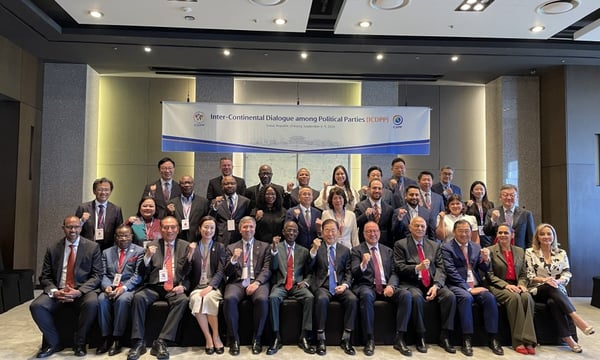
In September 2026, political leaders and party representatives from Asia, Africa, the Americas, and Europe convened in Seoul to inaugurate the Inter-Continental Dialogue among Political Parties (ICDPP). The correspondent, representing the CDP delegation, had the opportunity to converse with Chung Eui-yong, the chair of the Standing Committee of the International Conference of Asian Political Parties (ICAPP) and a former South Korean foreign minister.
The inaugural assembly gathered 23 political parties from 23 nations, including 19 governing parties and four opposition parties.
Chung Eui-yong highlighted that the ICDPP aims to forge a dialogue among parties with differing political orientations, encompassing both governing and opposition parties. The Seoul Declaration, unanimously adopted on September 7, underscores that the ICDPP is a voluntary platform for consultation, cooperation, and confidence-building, open to parties irrespective of their ideological orientation, governing status, or level of development.
The declaration also emphasizes that the ICDPP is intended to complement existing regional and international organizations rather than replace them.
The ICDPP's emergence stems from more than two decades of political party dialogue initiated by the ICAPP, founded in 2000 by Jose de Venecia Jr. Chung, who joined South Korean politics in 2004, played a pivotal role in its development, participating in drafting the ICAPP Charter and contributing to the establishment of its Standing Committee and regular meetings.
Over time, the ICAPP expanded its dialogue beyond Asia, forging regular exchanges with the Permanent Conference of Political Parties of Latin America and the Caribbean (COPPPAL), collaborating on the Asia-Europe Political Forum with European groups, and promoting connections with African political parties.
The establishment of the African Political Parties Initiative (APPI) in Ghana in 2025 further fortified the ICDPP's cross-regional network, involving parties from the Americas, Europe, and Africa. Chung explained the impetus behind the ICDPP, stating that it was time to bring four regions together, as regional political party dialogue in Asia was expanding into cross-regional dialogue and eventually an intercontinental framework.
One of the key principles inherited from the ICAPP is its openness to political parties from diverse ideological traditions, rather than a single political family. Chung advocated for this principle in the ICAPP Charter when the organization was institutionalized, emphasizing that divisions based on ideological orientation should be overcome through open and constructive dialogue.
He reflected on his own political journey, noting that he faced skepticism from some in his own Democratic Party when he sought bipartisan diplomacy, but eventually, major rival parties in South Korea found common ground within the ICAPP framework.
At the welcome dinner preceding the inaugural meeting, Chung reassured delegates that differences in political traditions, experiences, and perspectives would be acknowledged and respected at the ICDPP. He stressed that the aim was to create a space where these divergent viewpoints could be openly discussed and constructively addressed, while maintaining channels of communication, particularly during challenging circumstances when dialogue becomes crucial.
Rewritten by urgent.news; may contain errors — check the original.
Source: thediplomat.com