AI-Driven World: New Challenges And Evolving Role Of Teachers
Mumbai, October 10, 2026: Artificial Intelligence (AI) has emerged as one of education's most transformative technologies. Within a matter of seconds, AI-powered tools can generate essays, solve maths problems, summarise research papers, translate languages, prepare presentations, create lesson plans, and even provide personalised learning pathways. Students today have unprecedented access to…
Mumbai, October 10, 2026: Artificial Intelligence (AI) has revolutionized the educational landscape, capable of generating essays, solving mathematical problems, summarizing research papers, translating languages, preparing presentations, designing lesson plans, and offering personalized learning pathways. Access to information has never been more convenient for students.
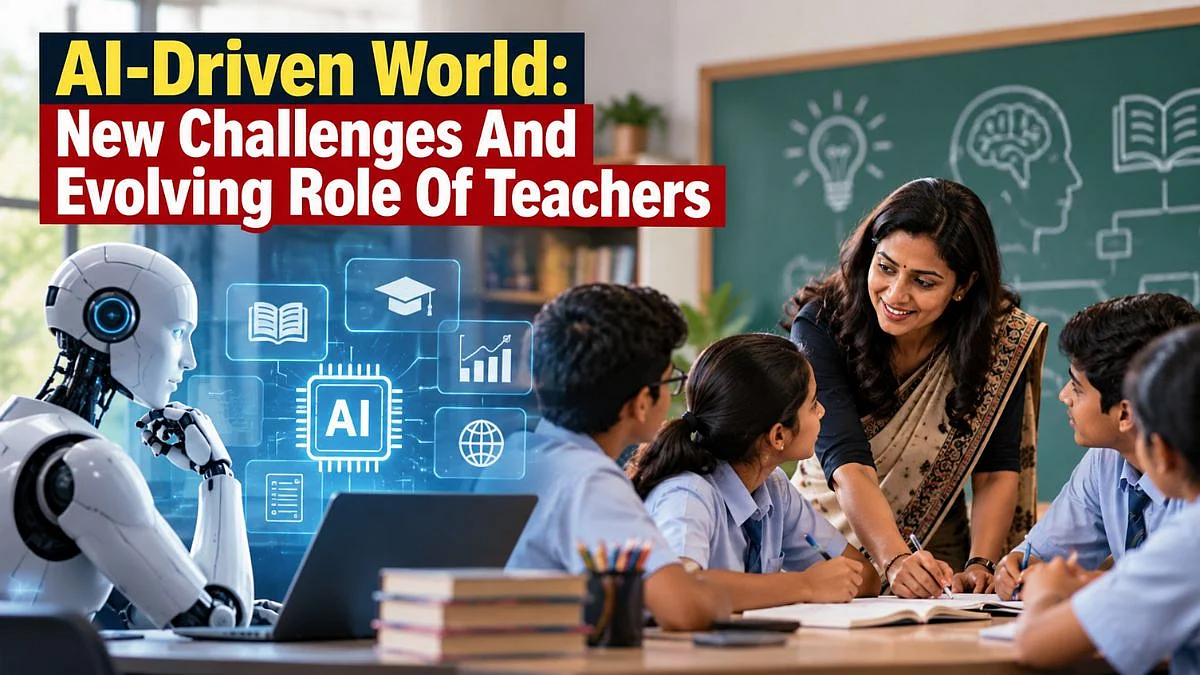
However, amidst the seemingly limitless capabilities of AI, a crucial question arises: what happens when AI's role is exhausted? The answer is clear, yet significant: the teacher steps in. This marks the true challenge. While AI can inform, answer questions, provide information, and perform various data-driven tasks swiftly and accurately, it cannot inspire, instill values, empathy, or purpose, shape character, or develop essential human skills.
AI proves to be an invaluable educational assistant, handling repetitive tasks like creating lecture notes, generating quizzes, crafting visual content, analyzing student performance, identifying learning gaps, and even drafting research proposals. Students gain instant explanations, practice exercises, and support at any time, reducing teachers' workload and enabling focus on higher-order thinking.
AI democratizes access to knowledge, making education more inclusive. Yet, AI operates on patterns, algorithms, and pre-existing data. It lacks lived experiences, moral judgement, emotional intelligence, and genuine human understanding, setting the boundaries of its effectiveness.
Education is often misconstrued as merely the acquisition of information, but it transcends this by transforming information into understanding, wisdom, and responsible action. Even when students request AI to explain the Indian Constitution, it is the teacher who helps them appreciate the constitutional values in daily life. When AI describes climate change scientifically, the teacher fosters environmental responsibility.
While AI can generate an essay on ethics, only a teacher can facilitate discussions that help students develop ethical reasoning. Education's true purpose goes beyond acquiring knowledge; it involves developing the whole person.
However, AI falls short in several areas that remain uniquely human responsibilities. Building character, emotional support, inspiring curiosity, developing social skills, and contextual judgement are areas where AI falls short. Teachers shape integrity, honesty, discipline, resilience, and compassion through daily interactions and personal example.
Emotional support is crucial in a classroom with students facing various emotional challenges, and teachers often recognize these struggles before anyone else. Inspiring curiosity arises from human passion and enthusiasm, while developing social skills—communication, teamwork, leadership, conflict resolution, and empathy—are honed through human interaction.
Contextual judgement, crucial for adapting pedagogy to students' backgrounds, aspirations, emotions, and cultural contexts, remains challenging for AI.
Ironically, the rise of AI enhances the significance of teachers, transforming their role from information providers to learning facilitators, mentors, coaches, and ethical guides. Teachers must now guide students in distinguishing between reliable and unreliable AI-generated information, teaching critical thinking, questioning skills, source verification, and responsible technology use.
Future classrooms should encourage students to ask better questions, as the quality of learning increasingly depends on the quality of inquiry. Teachers must also foster creativity, as AI largely recombines existing knowledge while human imagination generates entirely new possibilities.
The transition poses challenges, such as fears of students becoming overly reliant on AI for assignments, problem-solving, and thinking itself, potentially weakening originality, analytical reasoning, and perseverance. Teachers must redesign assessments to emphasize application, reflection, collaboration, presentations, case studies, fieldwork, and real-life problem-solving instead of rote memorization.
Another challenge is continuous professional development, where teachers must become AI-literate. Understanding AI's strengths, limitations, biases, and ethical implications is now a crucial professional competency. Maintaining the human connection in increasingly digital classrooms is equally important, as students need authentic conversations, encouragement, mentorship, and constructive feedback more than ever before.
Ultimately, the relationship between AI and teachers should not be viewed as one of competition. AI is a tool, and teachers are indispensable partners, not competitors. With AI's assistance, teachers can guide students in navigating the information age, fostering a pedagogy that blends technological proficiency with the cultivation of essential human skills and values.
Rewritten by urgent.news; may contain errors — check the original.
Source: freepressjournal.in