The Long Journey From A Mine To A Better District
A mineral begins below the ground, but its public journey is measured above it. The journey may end in a steel plant or a power network. It may also end in a village road, a school building, a health facility or a drinking-water project. That second journey is what gives India’s mineral economy a human scale. The district is where policy becomes visible Across India, 656 District Mineral…
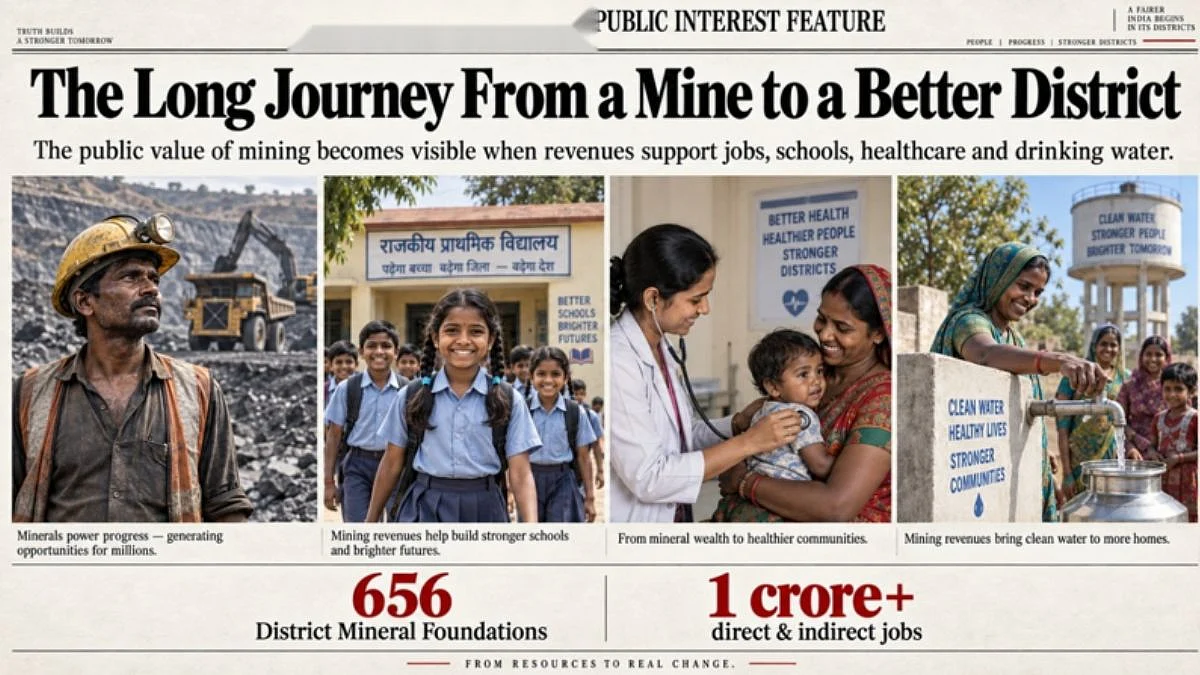
The journey of a mineral from beneath the earth to its application in public infrastructure is a complex one, with the district serving as the nexus. District Mineral Foundations (DMFs) are the mechanism through which royalty-linked mineral revenue supports local needs such as roads, schools, healthcare, and drinking water. In India, there are 656 DMFs, including 106 in aspirational districts, channeling mineral income into local development. Jharkhand, for instance, has collected ₹19,000 crore through DMFs across all its 24 districts.
The importance of this structure is clear: mining occurs in a specific geographical location, and for the value generated to return to local development, a credible route is needed. DMFs create this route, ensuring that mineral value contributes to district development. Beyond the immediate production site, mining supports a vast network of livelihoods and industries.
For example, non-coal mining supports over a crore direct and indirect jobs, while coal supports more than 25 lakh. The economic impact extends to sectors like steel, cement, power, railways, housing, defence, and solar industries.
The continuity of a mine's production is crucial for sustained benefits. A productive mine not only supports the workforce at the site but also generates employment in connected industries, as well as public revenue for the State and district. A mine that reaches sustained production can contribute across several years, with the public value growing through recurring production, royalty, premium, and linked district resources.
The State's share of mineral revenue has grown significantly, from 60.24 per cent in 2014-15 to 88.53 per cent in 2025-26, highlighting the increasing role of State capacity and district outcomes in the mineral economy.
Since 2015, over 720 mineral blocks have been auctioned, with 105 now operational. Coal has seen 141 auctioned mines, with 23 operational, while non-coal production has nearly tripled. Around 1,200 working mines have generated approximately ₹2.32 lakh crore in royalty, and roughly 100 operational auctioned mines have contributed around ₹96,000 crore in premium.
States like Odisha, which has auctioned 79 blocks and operationalised 34, demonstrate the strength of sustained execution. Odisha has accrued ₹87,000 crore in auction premium between FY 2020-21 and FY 2025-26, and there are 45 additional blocks in the pipeline.
The Mines and Minerals (Development and Regulation) Amendment Act, 2026, which came into force on 22nd August 2026, aims to create a more predictable framework for the valuable assets that generate public revenue. This law defines mineral-bearing land, inserts Section 9D into the MMDR Act 1957, and outlines conditions for State levies on mineral rights and lands.
Nearly 50 minor minerals remain under the existing State framework. The amendment treats prior amounts already deposited with or recovered by a State as settled, providing a clear framework for future levies. This reform story is fundamentally about continuity: a mine operates, families earn, States receive revenue, and districts gain resources for public priorities.
Written by urgent.news from Free Press Journal's reporting — not their text. Machine-written — may contain errors; check the original before relying on it.