Petrol discount or subsidy?
The federal government’s decision to offer a 30-day discount on petrol sold through the Nigerian National Petroleum Company Limited (NNPCL) stations has triggered debate on the state of subsidy, how the arrangement will work, who will ultimately bear the cost, among others. The Minister of Finance and Coordinating Minister of the Economy, Taiwo Oyedele, announced […]
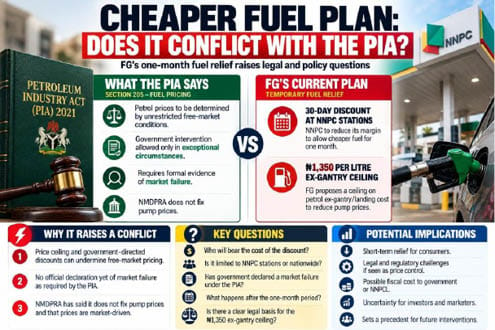
The Nigerian government has introduced a 30-day discount on petrol sold through its NNPC Limited stations, aiming to prevent fluctuations in pump prices due to global crude oil prices and exchange rates. Minister of Finance, Taiwo Oyedele, announced that this measure will prioritize public transport operators, who will be given discounted petrol.
The government is not reintroducing the subsidy, but rather implementing price modulation to stabilize pump prices. The plan includes negotiating a ceiling of N1,350 per litre for the ex-gantry cost of petrol, with refiners and importers bearing any shortfall if costs exceed the ceiling. The government is also working on forward crude sales to domestic refiners, increasing funding for cash transfers to vulnerable households, subsidising credit for small businesses, and accelerating the rollout of compressed natural gas (CNG) vehicles.
Independent marketers, represented by the Independent Petroleum Marketers Association of Nigeria (IPMAN), have called for inclusion in the initiative, stating that they must benefit from the discounted petrol as well.
Written by urgent.news from Daily Trust's reporting — not their text. Machine-written — may contain errors; check the original before relying on it.