Can China use widening yield gap between the US dollar and yuan to boost global role?
China should seize a window opened by the widening US-China yield gap to strengthen the financing, hedging and asset-absorption systems behind the yuan, turning its cyclical low-interest-rate advantage into lasting global use of the currency, according to a researcher from a Beijing-based governmental think tank. The 10-year US Treasury yield was 5.22 per cent on Thursday, compared with 1.69 per…
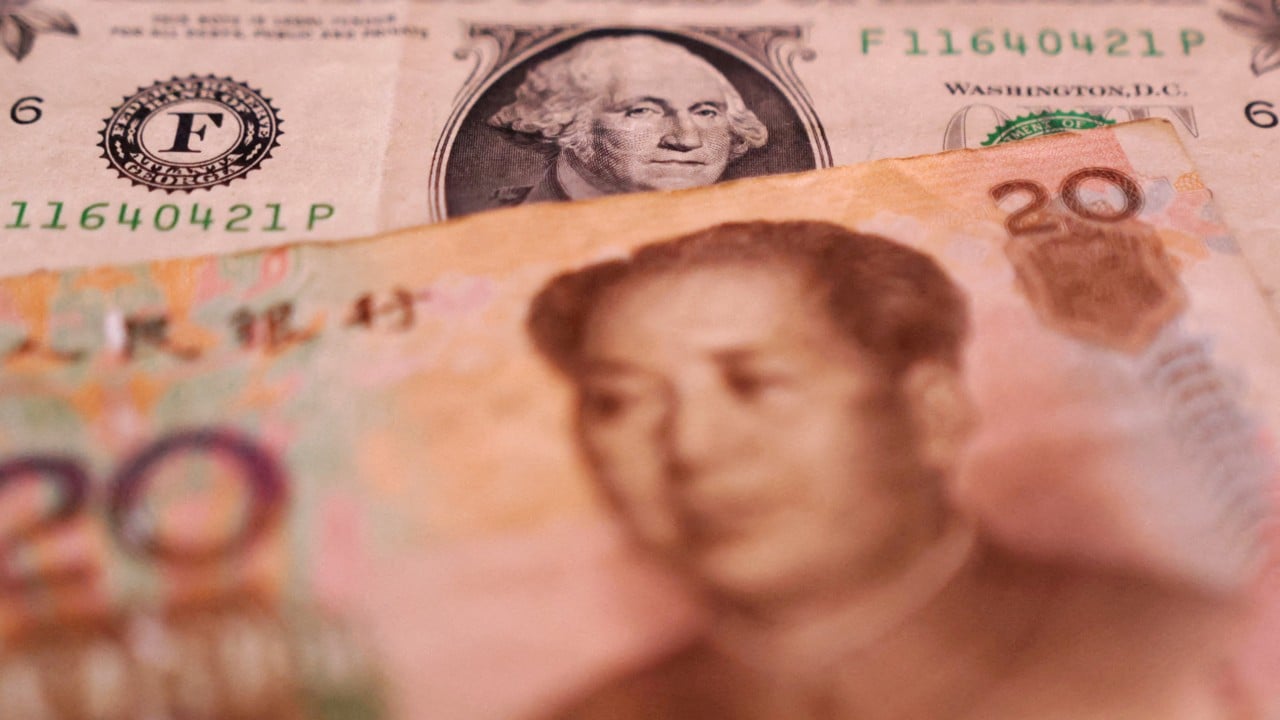
China should capitalize on the growing difference in yields between the US dollar and yuan to enhance the role of the yuan in global finance, according to a researcher from a Beijing-based governmental think tank. The 10-year US Treasury yield currently stands at 5.22 percent, while Chinese government bonds yield 1.69 percent after the first trading day following the National Day holiday – a 3.5 percentage point gap, compared to 3.7 percentage points on September 9.
Jiang Zhenlong, an associate research fellow at the Chinese Academy of Social Sciences' Institute of Finance and Banking, says that the widening yield gap benefits China's finances but pressures the exchange rate and capital flows. "The China-US yield inversion presents an asymmetric effect: pressure on the asset allocation side and benefit on the financing side," he writes in the latest issue of China Money Market, a central bank-affiliated magazine.
Borrowing in yuan has surged, with onshore and offshore yuan bond fundraising reaching 1 trillion yuan by early September, a record. However, this does not mean that there is a corresponding increase in demand to hold yuan assets. Jiang warns that the widening gap may lead to carry trades, where yuan is borrowed, sold, and used to buy higher-yielding foreign assets, potentially causing persistent selling pressure on the currency.
Currently, the yuan accounts for only 2.11 percent of global official reserves, compared to 56.70 percent for the US dollar. Jiang calls for measures such as tying yuan borrowing to real trade and investment, expanding offshore liquidity during stress, and developing longer-dated hedging tools to ensure the yuan's low-interest-rate advantage translates into long-term global use.
Hong Kong, the main hub for offshore yuan bond sales, has been expanding its offerings. Hong Kong Exchanges and Clearing launched the first five-year offshore Chinese government bond futures on August 3, and the Hong Kong Monetary Authority is exploring a seven-day offshore yuan liquidity tendering mechanism to improve access to short-term funding.
Jiang emphasizes that the yuan's low-interest-rate advantage can only become a lasting driver for internationalization if it is embedded in real economy and trade activity, highlighting the importance of improving the liquidity, convenience, and collateral functions of yuan assets.
Written by urgent.news from South China Morning Post's reporting — not their text. Machine-written — may contain errors; check the original before relying on it.