AI beginning to reshape recruitment criteria
Digital literacy is the only capability area in which fresh graduates meet employers expectations according to a new report Yet it is also the standard rising fastest as businesses increasingly expect new hires to use AI effectively in the workplace
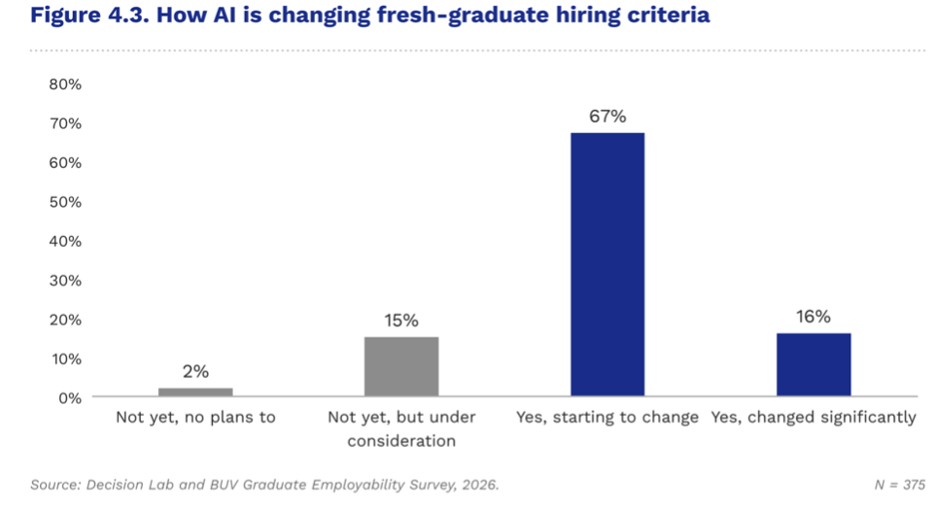
A recent survey by British University Vietnam (BUV) reveals that 83% of employers now consider AI to have altered or started to alter their hiring criteria, while 94% report that digital and AI capabilities are now essential, surpassing expectations from just two to three years ago. Nonetheless, businesses are not specifically seeking AI engineers; rather, they desire graduates proficient in common AI tools for daily tasks or issues unique to their roles.
This insight is part of a broader study titled "Beware the Gap – Are Graduates Set up for Success in a World of New Possibilities?" released on October 8 by BUV in partnership with research firm Decision Lab.
The research, based on a survey of 375 domestic and international companies, assessed seven key capabilities among fresh graduates. Employers deemed all seven areas crucial, yet graduates fell short in six out of the seven categories. Time management exhibited the most significant gap, at 26 percentage points, followed closely by problem-solving at 23 points.
Communication and adaptability also displayed notable gaps of 12 and 11 points, respectively. In contrast, digital literacy was the only area where graduates outperformed expectations by three percentage points.
Employers noted that these deficits become particularly pronounced in high-pressure environments, such as dealing with urgent tasks, limited information, or coordinating with multiple team members. In these situations, employers require staff capable of self-management, early identification of potential delays, and independent problem-solving, rather than relying on detailed instructions.
The study suggests that the disconnect between education and employment extends beyond academic knowledge to include graduates' ability to apply their learning, organize workload independently, and make decisions in real-world situations.
Interestingly, while 83% of employers acknowledge that AI has impacted their hiring criteria, only 3% require AI programming or data analysis skills. Instead, 79% of employers seek graduates who can fluently utilize common AI tools in their daily work or apply AI to solve specific problems relevant to their roles. This shift underscores a growing emphasis on merging technological proficiency with problem-solving and adaptability skills.
As AI tools become increasingly prevalent, candidates' competitive edge will be determined not only by their technological ability but also by their capacity to evaluate information, select appropriate approaches, and take ownership of their work.
However, the report highlights that collaboration between businesses and universities largely revolves around recruitment efforts. While 59% of surveyed employers have student interns, only 15% contribute to curriculum development, and 23% do not collaborate with any educational institution at all. To make internships genuinely effective in building capability, the report identifies three necessary conditions: meaningful work, close supervision, and demonstrating the student's contribution.
Therefore, to expand internship opportunities effectively, it is crucial to simultaneously enhance the quality of workplace experiences and encourage businesses to take a more active role in education and training.
Written by urgent.news from Vietnam Investment Review's reporting — not their text. Machine-written — may contain errors; check the original before relying on it.