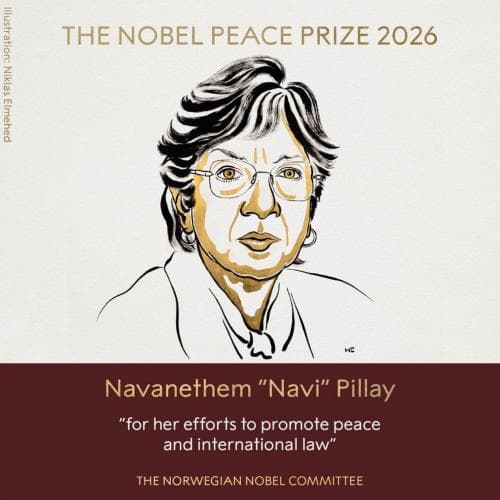
2026 Nobel Peace Prize awarded to South Africa's Navanethem 'Navi' Pillay for her efforts to promote international law
Pillay, 85, is a former UN human rights commissioner.
At least 24 vehicles were set on fire and foreign-owned shops were looted in South Africa during anti-immigration protests that turned violent in two major cities, police reported. The unrest erupted in Soweto, a sprawling township near Johannesburg, and Durban, a significant port city on the east coast. The violence followed a court ruling that required the government to remove barriers preventing some migrants from applying for asylum.
In Durban, the demonstration turned into violence after allegations surfaced that a foreign national had assaulted a protester. Police arrested three foreign nationals allegedly involved in the assault. Police responded by firing rubber bullets to disperse the crowds, with businesses closing in Durban's city center. Senior police officer Xolani Fihla confirmed clashes between foreign nationals and South African residents, but no injuries had been reported at that time.
In Soweto, 14 vehicles were torched, alongside gunshots during confrontations between residents and foreign shopkeepers. Acting national police commissioner Lt Gen Puleng Dimpane denounced the destruction of property. In Orlando West, Soweto, protesters initially demanded the closure of small convenience stores, or "spaza shops," operated by foreign nationals.
Protesters forced foreign traders out of some areas, resulting in attacks on shops and at least one building being set ablaze. Police deployed reinforcements to maintain order. Authorities vowed to pursue those responsible for the property damage. The unrest followed a July ruling by South Africa's Constitutional Court, which struck down restrictions on migrants applying for asylum based on how they entered the country or missed immigration deadlines.
The decision aimed to allow asylum seekers to submit applications, even if they entered South Africa without the necessary documents. The ruling prompted hundreds of people to gather at refugee reception centers, fueling anger among anti-immigration campaigners concerned that the decision would encourage undocumented migration. Government spokesman William Baloyi denied that people had spread false claims about the judgment, clarifying that the ruling does not automatically grant refugees status or permanent residency.
Applicants would still undergo individual assessments and immigration checks. Anti-immigration groups had previously staged weeks of protests demanding that undocumented foreign nationals leave the country by June 30. These protests led to tens of thousands of migrants fleeing, with some repatriated through government-organized programs.
South Africa has faced xenophobic attacks for nearly two decades, with violence resulting in over 60 deaths in 2008 and the displacement of tens of thousands of people. Recent tensions are exacerbated by widespread poverty, deep inequality and unemployment affecting about one-third of the workforce. Despite these challenges, South Africa remains a primary destination for migrants seeking employment, safety, and better opportunities.
Written by urgent.news from KahawaTungu's reporting — not their text. Machine-written — may contain errors; check the original before relying on it.
This story
This is one outlet's version. Read the fullest account.
- Cars torched and shops looted as anti-migrant violence erupts in South Africa myjoyonline.com
- Cars torched and shops looted as anti-migrant violence erupts in South Africa kahawatungu.com
- South Africa pulls asylum directive after violent protests dw.com
- Clashes lead South Africa to withdraw asylum processing order freemalaysiatoday.com
- Cars burned and shops looted as anti-immigration protests rock South Africa euronews.com
- Cars torched and shops looted as anti-migrant violence erupts in South Africa peopledaily.digital
- South Africa withdraws asylum processing following xenophobic clashes punchng.com
- The silent crisis of gender-based violence in Africa iol.co.za