Why Artificial Intelligence solves problems more like a pigeon than a human
While humans rely on logic and reasoning, both pigeons and artificial intelligence rely on trial-and-error, pattern recognition, and massive data memorisation to solve complex tasks.
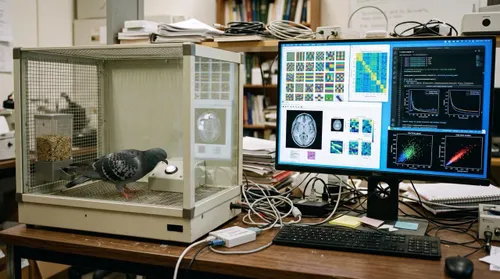
It's astonishing to many that pigeons process problems in a manner strikingly similar to artificial intelligence. While pigeons aren't renowned for their intellect, their cognitive parallel with AI arises from their shared affinity for swift pattern recognition and associative learning. In stark contrast, human intellect operates through logic, rule-based thought, and abstract deduction—abilities that pigeons and existing AI lack.
Much like AI, pigeons rely almost solely on trial and error. Consider a pigeon encountering a vividly colored seed—typically a warning signal for toxicity to other creatures. Without innate aversion, the bird consumes the seed, only to experience a direct negative physical reaction and subsequently modify its approach. Despite their modest mental capacity, pigeons excel at visual memory and can discern intricate patterns at breakneck speed.
Similarly, AI thrives at processing massive data sets and formulating precise operational conclusions, all without grasping the underlying concepts. Notably, neither AI nor pigeons engage in abstract reasoning. Neither system comprehends the rationale behind a correct answer; they merely recognize that a specific input produces a specific result.
They heavily depend on their data storage capability, which AI harnesses to predict statistical outcomes. Through relentless repetition, the ordinary pigeon progressively enhances its performance on specific tasks. AI replicates this iterative learning process, albeit on an exponentially greater scale. Rats emerge as a noteworthy contrast.
Widely regarded as among the most intelligent small animals, rats are exceptional problem solvers, frequently outperforming dogs in complex visual and physical challenges. Their remarkable spatial memory enables them to chart environments and navigate obstacles with strategic cunning. Due to this sophisticated internal psychology, rats align more closely with human cognition than either pigeons or artificial intelligence ever will.
Written by urgent.news from IOL's reporting — not their text. Machine-written — may contain errors; check the original before relying on it.