The 25 January 2026 landslide at Niscemi in Sicily, Italy
On 25 January 2026, a very large landslide reactivated at Niscemi in Sicily, Italy. A new paper in the journal Landslides (Guerriero et al. 2026) describes the event. On 25 January 2026, a large landslide reactivated at Niscemi in SE Sicily, Italy. The landslide attracted a great deal of media attention. About 1,500 people were […]
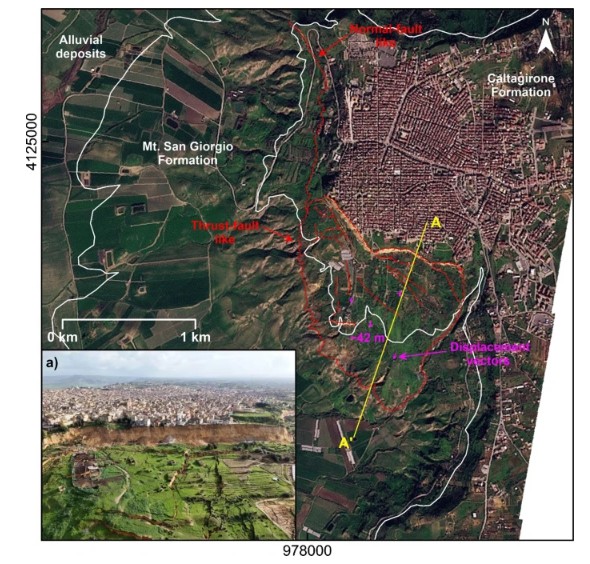
On 25 January 2026, a massive landslide reactivated at Niscemi, a historic town in southern Sicily, Italy. The event garnered significant media attention, leading to the evacuation of about 1,500 residents and causing damage to infrastructure and buildings. A new study, published in the journal Landslides by Guerriero et al. (2026), analyzes the landslide and its triggers.
Niscemi, situated at coordinates [37.1467, 14.3973], is built on a mesa composed of sandstones and clays that rest atop a gypsum layer. A major landslide had previously occurred on the southern side of the mesa on 18 March 1790. Another significant landslide took place on 12 October 1997 over an area of roughly 2 km². This particular slope reactivated once again on 25 January 2026.
The authors suggest that the landslide was triggered by rainfall associated with Cyclone Harry, which passed over the area about a week prior to the failure. The landslide affected approximately 1.3 km², with a maximum length of around 1.3 km. Using Interferometric Synthetic Aperture Radar (InSAR) data, Guerriero et al. (2026) found limited movement on most of the landslide complex, with only a small portion showing deformation.
The total movement during the 25 January 2026 event reached up to 50 meters, causing considerable damage. The authors provide a geological cross-section of the landslide, illustrating potential pre-existing failure surfaces and areas of deformation. The failure, which is deep-seated (70 meters) and occurs on a low-angle shear surface, is primarily driven by weak materials and high pore water pressures.
Despite Sicily's typically dry climate, rainfall totals were surprisingly low – less than 35 mm in the week leading up to the failure, with 21.0 mm falling on 20 January 2026.
Written by urgent.news from Eos's reporting — not their text. Machine-written — may contain errors; check the original before relying on it.