OpenAI withdraws three preprints a day after releasing 722 manuscripts on unsolved math problems
Less than 24 hours after OpenAI posted over 700 preprints describing major math results by an internal AI model, the company has withdrawn three of the manuscripts for errors. On Oct. 6, OpenAI published 722 preprints in a GitHub repository about purported progress in solving 372 math problems in geometry, computer science, algebra and other … Continue reading OpenAI withdraws three preprints a…
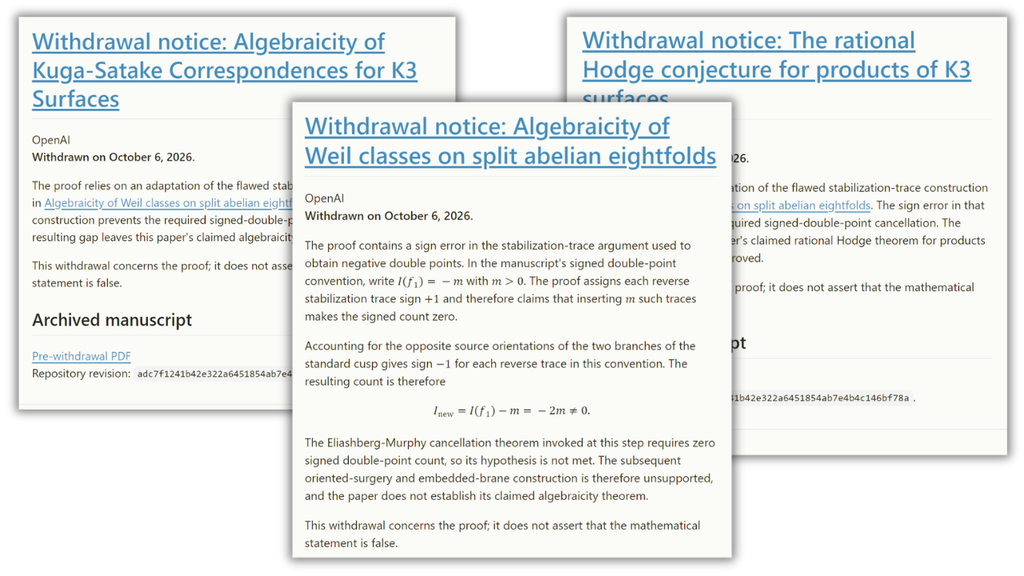
OpenAI removed three preprints from a GitHub repository containing 722 manuscripts about unsolved math problems just a day after releasing them. The company published the preprints on October 6, claiming the effort aimed "to push the frontier of human knowledge and enable further progress in mathematics." However, on October 7, OpenAI announced the withdrawal of three papers due to a sign error.
This error invalidated an argument in one manuscript and the construction used in two dependent papers. OpenAI released notices explaining the gaps and stated that they have revised 14 other manuscripts with proof repairs, corrected statements, clearer hypotheses, and dependencies. Alex Townsend, a Cornell University mathematics professor, suggested that more errors might be found in the OpenAI manuscripts.
OpenAI identified the errors during an audit, and the company is open to feedback from the mathematical community. They stated that they will work to correct errors promptly and withdraw papers if no fixes can be found. OpenAI's collaboration with the Advisory Group on Mathematics and Artificial Intelligence (AGMAI) recommended releasing the results without full formalization, with roughly 50% of the results being unconfirmed.
Andrew Sutherland, a senior research scientist at MIT, appreciated OpenAI's quick response to the errors, but emphasized that many mathematicians are unhappy with how OpenAI handled the September 8 announcement of an AI system solving the Navier-Stokes problem. The Navier-Stokes problem asks whether a series of equations describing the movement of gases and liquids become unreliable at some point.
Over 8,000 researchers have expressed concern over OpenAI's handling of the Navier-Stokes announcement. The Association for Human Mathematics criticized the recent release, stating that releasing over 700 files at once is not a demonstration of scholarship, but rather a demonstration of power. They urged mathematicians to discontinue their work with OpenAI and return to a vision of science that centers human understanding.
Written by urgent.news from Retraction Watch's reporting — not their text. Machine-written — may contain errors; check the original before relying on it.