James Webb telescope pinpoints the most distant 'fast radio burst' ever seen
The James Webb Space Telescope has detected the farthest "fast radio burst" ever seen, providing more clues about these mysterious explosions.
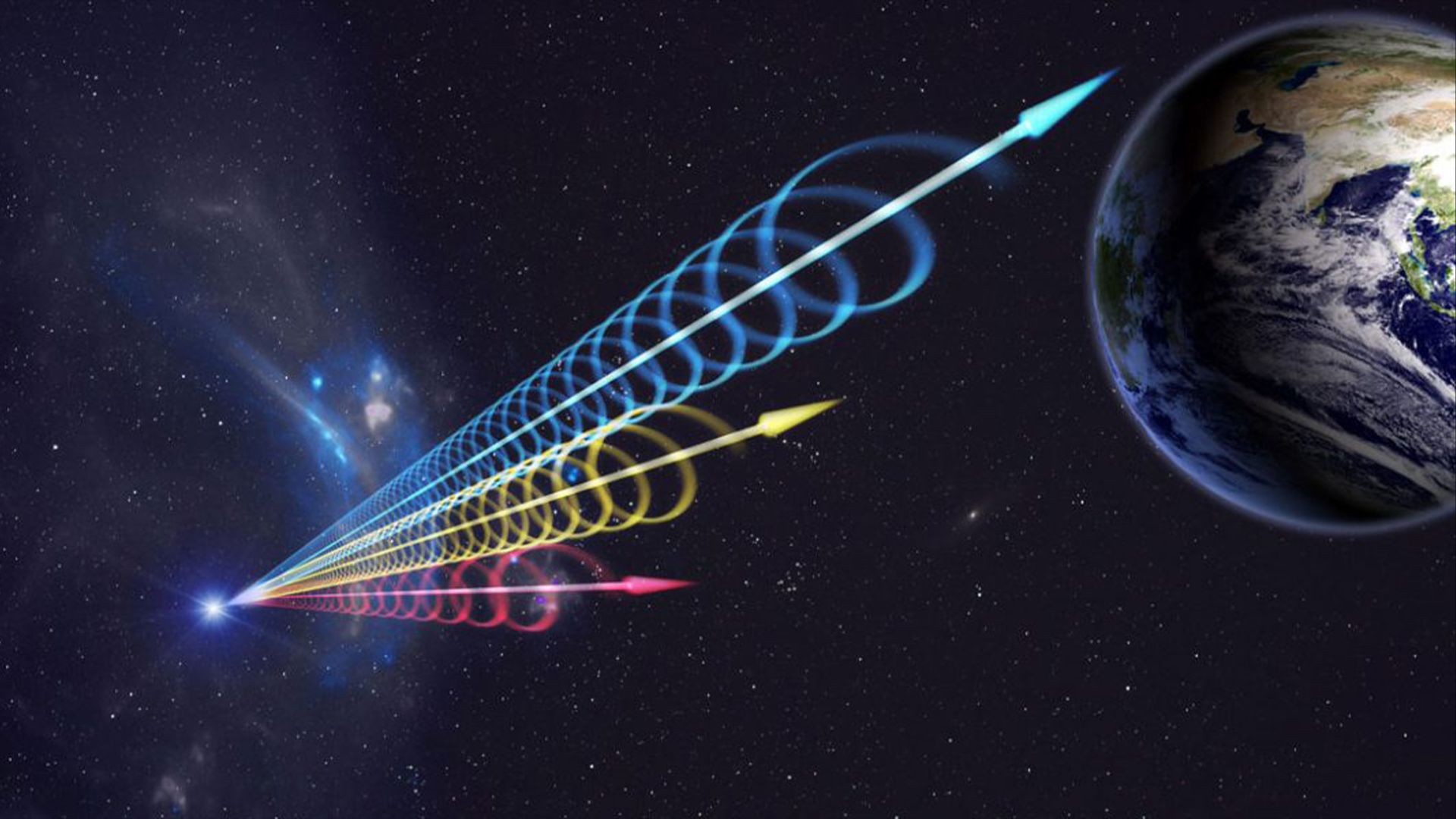
Scientists have discovered the most distant fast radio burst (FRB) ever observed, originating from a galaxy located over 10 billion light-years away. FRBs are brief, intense bursts of radio waves, and studying them is challenging due to their fleeting nature. In this instance, astronomers utilized the James Webb Space Telescope (JWST) alongside a radio telescope array called MeerKAT to pinpoint the FRB's host galaxy.
The JWST's observations revealed that the galaxy is smaller, metal-poor, and actively forming stars, which could provide valuable insights into the environments surrounding FRBs. The researchers suggest that the FRB might be linked to a magnetar, a magnetically charged stellar remnant that forms after a supernova explosion.
The FRB, designated FRB 20240304B, was first identified using MeerKAT. However, it was challenging to locate the galaxy responsible for the burst using ground-based telescopes. The researchers eventually achieved success with JWST through its Director’s Discretionary Time program. This allowed them to take a deep image of the FRB's location and obtain a spectrum, which provided the necessary data to determine the galaxy's precise redshift – indicating its distance and age.
The host galaxy is relatively young, existing when the universe was around three billion years old, or about one-fifth of its current age. This discovery supports the theory that some FRBs are generated by magnetars, which are more likely to form in galaxies with intense star formation activity. The team intends to continue searching for FRBs using JWST, as the telescope's capabilities can offer a more comprehensive understanding of these mysterious cosmic events.
Written by urgent.news from Live Science's reporting — not their text. Machine-written — may contain errors; check the original before relying on it.