From prayer to livestreams: The changing face of Raam Bhajan in South Africa
Raam Bhajan remains a devotional practice, but in South Africa it has also become a cultural gathering, social space and increasingly visible digital experience.
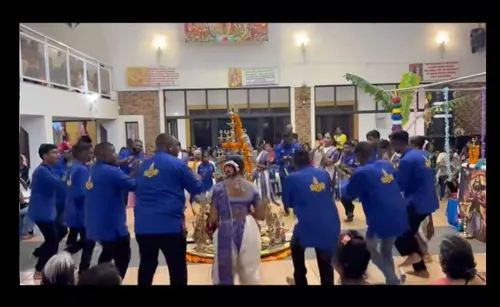
The contemporary Raam Bhajan in South Africa has evolved significantly from its roots in devotional singing. It is now more than just a religious gathering; it serves as a cultural expression, social occasion, and is widely shared on social media. Held during the month of Puratassi, the Bhajan features energetic singing, rhythmic clapping, and synchronized movements. Participants perform a series of coordinated gestures and formations, which creates a unique shared physical language.
The evolution of Raam Bhajan in South Africa began with the arrival of Indian indentured laborers in Natal during the 1860s. These immigrants brought with them their religious practices, languages, music, and forms of worship. Over time, these traditions were shaped by the realities of life in South Africa, resulting in a unique South African iteration of the Raam Bhajan.
One of the most noticeable developments in recent years is the incorporation of choreography into the Raam Bhajan. This adds a visual dimension to the experience and allows people to participate physically even if they do not know all the words. The movement creates a sense of collective connection and unity, transcending the limitations of individual singing.
South Africa boasts a multitude of Raam Bhajan groups, each with its own distinct character, history, and community following. From the Shree Radha Krishna Bhajana and Thirupathie Seva Raam Bhajan Group to the Campbells Town Shree Raam Bhajan Group, Shree Pranava Bhajan Group, and Shree Pranava Bhajan Group, the landscape is diverse and extensive.
Young people, especially young women, are actively participating in these gatherings, moving beyond their traditional roles as observers or accompanying family members. They contribute to singing, movement, and event organization.
In addition to their religious significance, Raam Bhajans have also become a social space where young people can meet, families can observe, and matchmaking opportunities may arise. These events bring together faith, community, culture, and sometimes even romance, all under the blessing of Hari Narayana.
The contemporary Raam Bhajan is no longer confined to those physically present at the gatherings. With the rise of social media, recordings and livestreams of these events are shared across platforms, allowing people worldwide to experience the divine and celebratory atmosphere. This accessibility has allowed the Raam Bhajan to reach a global audience, transcending geographical boundaries and connecting devotees from across the Hindu diaspora.
Written by urgent.news from IOL's reporting — not their text. Machine-written — may contain errors; check the original before relying on it.