Frankreich: Emmanuel Macron in der Schuldenfalle
Hohe Defizite, steigende Zinskosten und politische Blockaden setzen Frankreich unter Druck. Vor der Präsidentschaftswahl 2027 wird die Lage immer heikler.
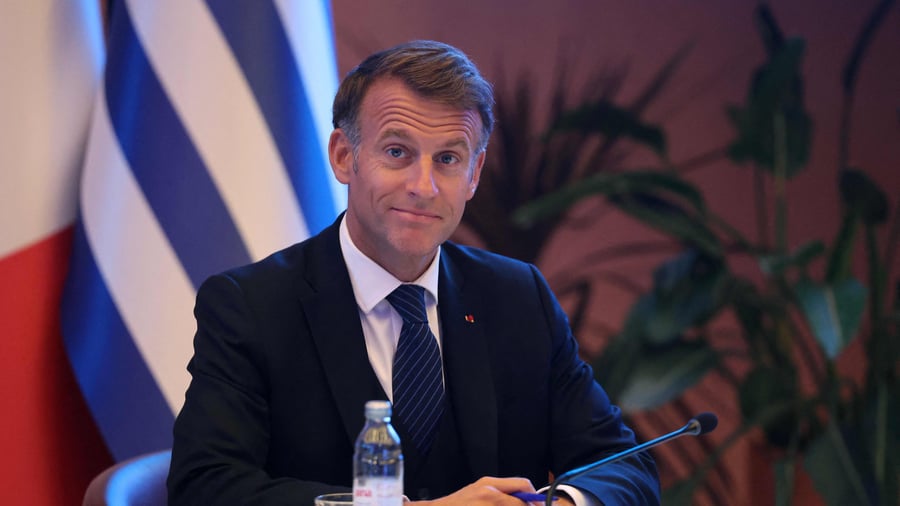
Emmanuel Macron, the French President, is currently in a debt trap. With only seven months left in his term, his presidency could become the most challenging one yet. High debt levels, rising bond interest rates, and political deadlock are making France a risk factor for the Eurozone, and the President has less power to counteract the situation.
His government is trying to push the final budget through without its majority to calm the markets, but any cuts risk provoking protests on the streets and in Parliament. Even Kristalina Georgieva, the IMF chief, warns CNBC, "Straighten out your shop." Global geopolitical tensions are pushing bond interest rates up. For France, the yield on 10-year government bonds is just under five percent, which is on par with the peak levels of the 2008 financial crisis.
The risk premium for French bonds compared to German bonds has risen for the first time since the Euro debt crisis, reaching over 150 basis points. This makes France riskier to trade on the bond market than Italy or Greece. Economy Minister Roland Lescure assures that France's creditworthiness is solid, but he emphasizes the financial space the country needs.
"The problem is that we have to pay more and more for our debts," he told journalists. For 2026, the government expects around 80 billion euros in debt service, for 2027 over 91 billion euros. IMF chief Georgieva called France's debt staircase "a staircase that doesn't lead to heaven." France is one of the most indebted countries in the EU.
At the end of the second quarter, the debt ratio stood at 119 percent of gross domestic product, and it is expected to reach almost 122 percent next year. High debt is not only a consequence of recent crises, but it is also structural. France has not had a balanced budget for over 45 years. Macron set out to break this tradition, but he achieved only a reduction in new borrowing to below three percent in the early stages of his presidency.
Then a series of major crises followed. However, they do not solely explain why France is facing such pressure now. The COVID-19 pandemic has taken the situation out of control. Prime Minister Jean Castex announced new aid on the fly, with the motto "Quoi qu'il en coûte" (in German: "It costs what it costs"). While other countries rolled back their aid, France continued to pay generous inflation aid and, starting in 2021, a 100-billion-euro package to cushion rising energy prices.
Regular protests and social unrest prompted the government to respond with costly concessions. Adding to the tax policy, Macron's tax and duty cuts since 2018 were not fully financed. This included tax cuts for businesses, the abolition of the housing tax, and relief on social charges. These measures made the country more attractive to investors but also resulted in lower revenues.
The Court of Auditors estimated the impact of these tax cuts at around 62 billion euros for 2023 alone, which was not offset by corresponding spending cuts. Thus, the tax cuts contributed to the worsening deficit and the increase in public debt, also because growth fell short of expectations. The government has just had to lower the growth forecast for this year to 0.5 percent.
The austerity plan without a majority aims to reassure markets. The government now presented a budget that provides for savings of 54 billion euros in total. Of this, 43 billion euros are to come from new measures, such as cuts in ministries or a slowed growth of social expenditures. A further debt issuance of more than five percent is "not negotiable," says the Economy Minister.
Yet this is becoming increasingly difficult politically, as the government no longer has its own majority. Two governments have already fallen over the budget in 2024 and 2025. A compromise was only reached last year because the heavily contested pension reform - Macron's political flagship project - was put on hold. Now, with the presidential election approaching, resistance is growing.
Protests are putting pressure on the government. Following recent student protests, the government has already rolled back several cuts announced just days earlier, including tuition fees for certain courses and preparatory classes. More nationwide protests against high living costs and the government's austerity plans are announced for early October.
These further fuel the pressure. The Socialists and the extreme left LFI have already threatened to bring down the government with a motion of censure. Marine Le Pen of the right-wing National Rally, who is currently leading in the polls, would have an interest in stability before a possible presidency and could even support a budget in doubt to gain politically.
However, if the resistance against austerity measures grows, even the Socialists might compromise to profit politically. France does not admit it could need help. The European Central Bank has a tool called the Transmission Protection Instrument (TPI) to purchase bonds of individual Eurozone countries and limit their risk premiums.
"We must prevent this at all costs," says Economy Minister Lescure. With Macron's power waning, he can only change the situation to a limited extent.
Written by urgent.news from Handelsblatt's reporting — not their text. Machine-written — may contain errors; check the original before relying on it.