Elektromobilität: So abhängig ist Europa bei Batteriezellen
Die Batteriezellen für Elektroautos sollen verstärkt in Europa gebaut werden. Die technologische Abhängigkeit von Asien sinkt damit aber nicht unbedingt.
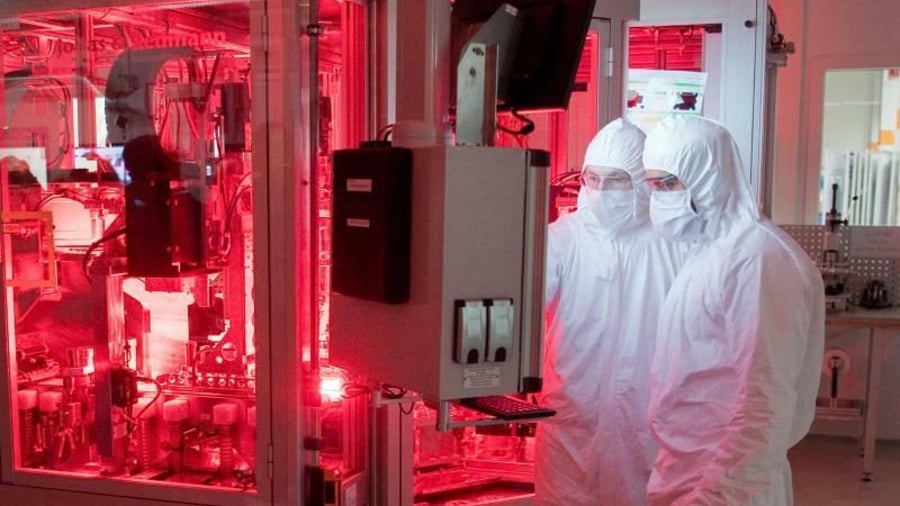
Europa's automotive industry relies on battery cells, preferably not directly from the dominant producer China. Two recent studies reveal how complicated the overall situation is and how the issue has recently shifted from manufacturing to costs, cell chemistry, and materials. Both studies should be considered with caution as they are both clearly written from a lobby perspective, though their synthesis provides valuable insights.
A study commissioned by the European Automobile Manufacturers' Association (ACEA) warns of significant shortages of European battery cells, while the Environmental Organization Transport & Environment (T&E) concludes that the EU could easily meet future demand through domestic production. The apparent contradiction lies in different assumptions and interests surrounding the planned "Industrial Accelerator Act" of the EU, which aims to ensure that public funding is more closely tied to production in Europe.
By 2027, electric cars are expected to be assembled in the EU with a high proportion of European components, and by 2030, the standards will even cover the cathode material. However, for European manufacturers, this could become problematic. The industry study expects a significant expansion of cell production in the EU, from around 90 GWh in 2025 to 306 GWh by 2032.
However, a portion of this production would likely be exported, leaving around 170 GWh for the European market itself. This results in a temporary gap of around 150 GWh between available European production and the demand that could arise from incentive programs and potential EU rules. Despite warnings of pessimistic shortages, T&E believes the EU could produce enough home-grown cells for companies meeting the planned rules by 2027, and possibly also for privately funded electric cars by 2030, provided that both high and medium likelihood projects are actually built.
However, this is not guaranteed, as T&E has noted that around a quarter of announced European cell capacities have been canceled or postponed since 2022. While Europe's battery industry is growing, it is not necessarily becoming independent from China, with much of the know-how and capital still coming from Asia. Volkswagen's subsidiary PowerCo started producing self-developed unified cells in Salzgitter by the end of 2025, with capacity ranging from 20 GWh to 40 GWh, and CATL began test production in Debrecen, Hungary.
These developments show that China's help is essential, as demonstrated by Volkswagen's recent deepening cooperation with Gotion High-tech to produce LFP cells and cathode materials in Spain. While Europe may soon have more production capacity, it may not be for the cell types most in demand by the market, leading to significant cost disadvantages.
According to the ACEA study, European-made cells are currently 24 to 33 percent more expensive than imports from China, even when produced in China.
Written by urgent.news from Handelsblatt's reporting — not their text. Machine-written — may contain errors; check the original before relying on it.