Bronze ring engraved with Lighthouse of Alexandria found in sunken royal palace
For centuries, anyone hoping to picture the Lighthouse of Alexandria has had to make do with fragments: worn coins, a handful of mosaics, and the impressions of travellers who saw it before earthquakes toppled it. Now a new image of the ancient beacon has emerged, and it fits on a finger. Underwater archaeologists have recovered a bronze signet ring from the sunken island of Antirhodos, engraved…
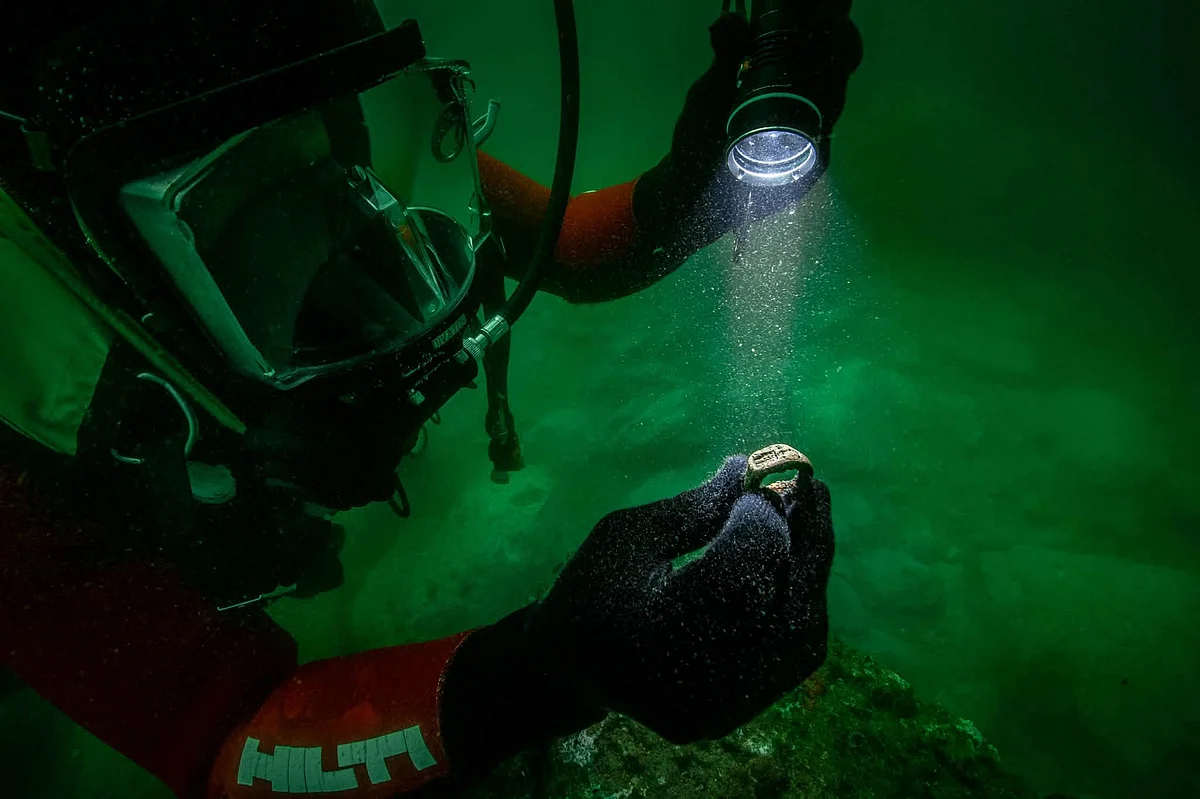
For centuries, the enigma of the Lighthouse of Alexandria has been fueled by fragmented clues: weathered coins, a few mosaics, and tales from travelers who beheld it prior to earthquakes bringing it down. Now, a fresh image of the ancient beacon has surfaced, compact enough to rest upon a finger. Underwater archaeologists have unearthed a bronze signet ring while surveying the submerged island of Antirhodos, bearing a multi-tiered design identified as the Pharos, according to the European Institute for Underwater Archaeology (IEASM).
The institute declared the discovery on Wednesday. The island, once nestled within the royal complex of Alexandria's Portus Magnus, or the Great Harbour, holds historical significance. Prior to Egyptian authorities, no ring displaying the lighthouse's engraving had been discovered. Dr. Hisham El-Leithy, the Secretary-General of the Supreme Council of Antiquities, termed the find exceptional.
The inscriptions on the ring mirror the lighthouse's portrayal on coins minted in Alexandria during the 2nd century AD, hinting at a possible dating to that era. Signet rings were not mere adornments in antiquity; they were functional tools. Used to imprint wax or clay, they served as official signatures, verifying a document or shipment bore the bearer's authority.
The location where this ring was unearthed has piqued researchers' interest. Antirhodos did not merely boast a shoreline; it housed a royal palace, and Franck Goddio, the French explorer leading the excavation, has highlighted the importance of recovering the ring from such a center of power. The team believes the discovery might imply that the palace continued to serve official purposes into the 2nd century AD, potentially including tasks linked to lighthouse administration.
Beyond the ring, the mission retrieved a range of ceramics, encompassing everyday utensils, tableware, and amphorae, spanning approximately eight centuries from the 4th century BC to the 4th century AD. Fragments of ancient glassware were also part of the haul. Goddio's team has been surveying Antirhodos since 1992, uncovering a Ptolemaic palace linked to Cleopatra VII.
The Lighthouse of Alexandria, constructed in the early 3rd century BC on the Pharos island, stood tall over the harbor, guiding ships through treacherous waters. It remained active for over a millennium before earthquakes ultimately caused its collapse. Today, remnants of the structure lie scattered on the seabed near the Qaitbay Citadel.
The ring now offers a fresh, and rather personal, perspective on how the ancient world perceived one of its most renowned landmarks. Upon the completion of this season's exploration in the Eastern Harbour, the mission plans to continue its underwater investigations in Abu Qir Bay.
Rewritten by urgent.news; may contain errors — check the original.
Source: gulfnews.com