Autoindustrie: Diese beiden SUVs entscheiden die Aufholjagd von BMW und Mercedes – einer liegt deutlich vorne
Mit ihren Elektro-Modellen iX3 und GLC wollen beide Premiumhersteller endlich elektrisch durchstarten. Exklusive Zahlen zeigen deutliche Fortschritte – und einen abgeschlagenen Dritten.
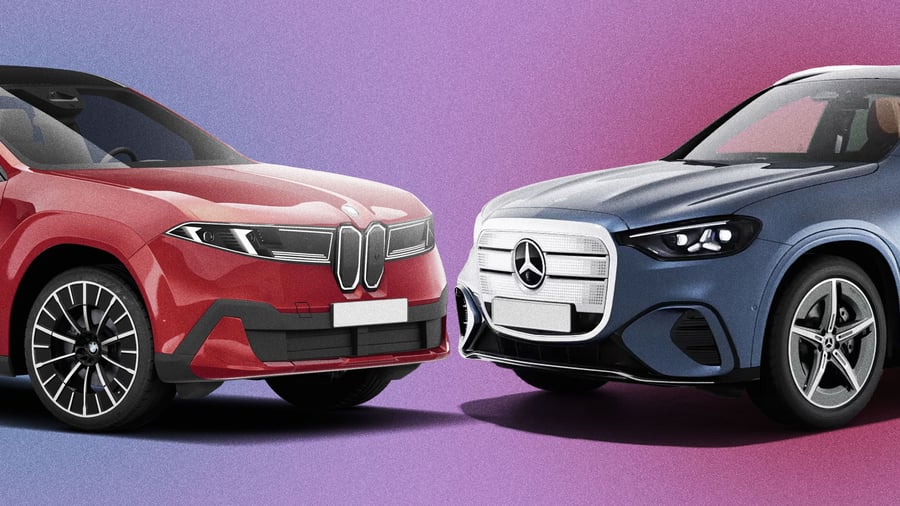
BMW's iX3 and Mercedes' GLC are the focal point of a crucial duel between the two automakers, known as the "models of fate." The two electric SUVs were introduced at the IAA auto show in Munich last year. A half a year after their market launch in Europe, the Handelsblatt analyzes their sales figures and finds a clear winner. Between March and August, over twice as many buyers in Europe opted for the BMW iX3, with 36,500 new registrations compared to just over 16,100 for Mercedes' GLC, according to Dataforce's registration numbers.
The iX3 and GLC represent more than just sales numbers. For Mercedes and BMW, respectively, the two electric vehicles mark a significant relevance for the future of their respective conglomerates. The iX3 marked BMW's rollout of the future platform "New Class," while the GLC was considered a "fateful model" by Mercedes' CEO, Ola Källenius.
The electric vehicles are expected to turn the decline in sales and generate profits. The electrification in Europe continues to advance, and Chinese competitors are pushing into the market. It is essential to defend the brand position as a premium manufacturer with technologically advanced models. Both iX3 and GLC are software-based vehicles equipped with the latest battery generation, promising fast charging times and high ranges.
In comparison tests, both vehicle lines receive praise. The iX3's sales were notably higher in the spring compared to the GLC, mainly because the market launch occurred two weeks earlier. More importantly, the GLC faced temporary supply issues in the spring, which included a shortage of batteries from the Chinese supplier CATL and difficulties in sourcing powertrains due to a supply chain disruption.
These issues were resolved, causing GLC new registrations to surge since June, being nearly eleven times higher than in March. On a month-to-month basis, Mercedes nearly caught up with the iX3, with 6,700 adoptions in August, compared to 5,400 for the GLC. In July, the gap was more than twice as large. BMW launched the iX3 at a high level from the spring, surpassing the 10,000 new registrations mark in Europe as early as May.
Since a high point in June with nearly 8,000 new registrations, the trend has slightly declined. Customers have reportedly purchased the car without ever driving it, with some even switching from Tesla to BMW. Mercedes dealers, on the other hand, are satisfied with the development of the new model. BMW repeatedly emphasizes that the business with the electric SUV should continue to be good.
The company has already reported that the iX3 has surpassed 100,000 reservations, and the orderbook is filled until the second quarter of the following year. Mercedes does not disclose reservation numbers, but management shows satisfaction with the demand for the GLC. It is the most sold electric vehicle in the history of the Swabians.
Production in Bremen operates in a three-shift system, with electric models selling out by the end of the year. Internally, Mercedes speculates that BMW may overtake them by the end of the year. Tesla's Model Y sells better. According to Dataforce numbers, Mercedes and BMW are gaining relevant market shares in the midsize electric SUV segment since the beginning of the year.
BMW leads with a 7.7% share of new registrations in the midsize electric SUV segment, trailing far behind Tesla's Model Y and Skoda's Enyaq. Mercedes holds the tenth position with a market share of 3.3%. Both brands are also well-positioned in the business with corporate customers: For BMW, over 57% of new registrations come from fleets, while for Mercedes, it is 50%.
Private buyers account for 29% of new registrations for BMW and 27% for Mercedes. Mercedes makes up 22% of sales through weak-margin leases and sales to car rental companies, while for BMW, it is only 11%. The new electric SUVs sold better than their traditional counterparts in the past months, which have been on the market for several years.
While the traditional GLC was registered 4,500 times in August, the electric model sold 5,400 units. The BMW iX3 performed twice as well as the X3, selling 6,700 units. No turnaround in China can be expected in the near future, as the sales of German automakers in the People's Republic have been declining for years. This year, the trend has intensified, causing margins and profits to dwindle.
BMW had to issue a profit warning in June due to a poorer-than-expected performance in China, and Mercedes had to adjust its sales forecasts downward. For years, Mercedes and BMW have benefited from the diesel business in China. However, local competitors have now overtaken the German traditional firms in the electric vehicle market.
This should change with the market introduction of the iX3 and GLC. Both manufacturers offer their models with local software and longer ranges.
Written by urgent.news from Handelsblatt's reporting — not their text. Machine-written — may contain errors; check the original before relying on it.
This story
This is one outlet's version. Read the fullest account.