Anleihen: Der Zins-Schock – und wie er die Märkte verändert
Wachsende Verschuldung, hartnäckige Inflation, verunsicherte Märkte – wie die neue Zinswelt sich in die Weltwirtschaft hineinfrisst und die Finanzstabilität gefährdet. Besonders betroffen einmal mehr: Europa.
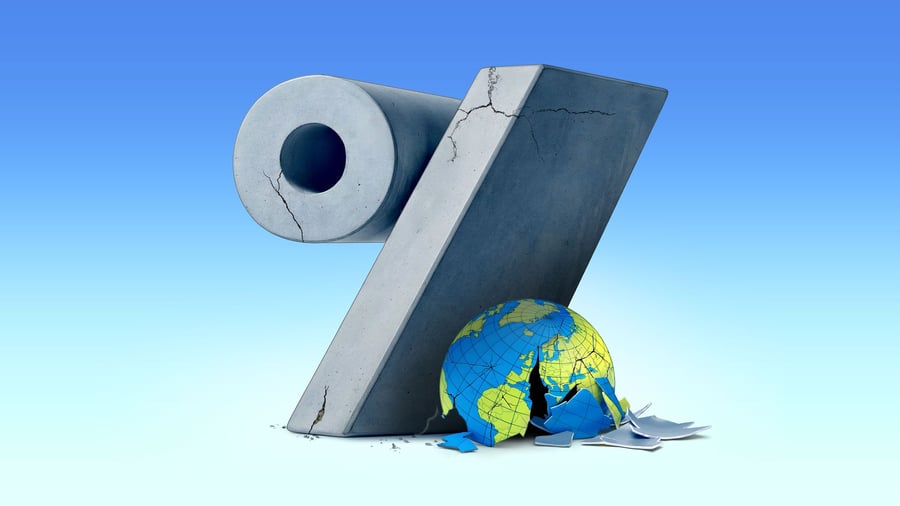
The rising interest rates are putting pressure on global financial markets and testing the high debt levels of governments. The United States is at the center of these concerns, with consequences extending far beyond the bond market. This article explains how the new interest environment affects Europe and the US, why confidence in US fiscal policy is waning, and what factors are driving yields higher.
The article also examines why the era of low rates is over and the implications of rising yields for heavily indebted states, the ECB, and financial markets. An in-depth interview with Clemens Fuest in the Handelsblatt provides further insights into this complex situation. Mohamed El-Erian, often considered the Bond economist among American economists, explained in a recent podcast that "it's our debt, but it's your problem."
He was referring to a famous quote by former US Treasury Secretary John Connally from 1971, when the United States unilaterally abandoned the dollar's gold backing, rattling the global monetary system. El-Erian's comment underscores the gravity of the current situation: "America exports its debt crisis" - a rather mild description of the turmoil seen in bond markets in recent days and weeks.
Financial market participants now call the sharp rise in long-term capital market interest rates a "Bond Beben." These yields have breached critical marks in many parts of the world, moving at breathtaking speed. The US 10-year bond, a global benchmark, has surged above the 5% mark, currently standing at 5.33%, the highest level in nearly 25 years.
Germany's equivalent stands at 3.5%, while France and Italy must offer yields of 4.9% and 4.7%, respectively. Even US 30-year bonds are nearing the 6% mark. The world's largest bond market is triggering a wave of events that extends far beyond international bond markets. From mortgages and leasing contracts to corporate bonds and traditional company loans, no area has remained untouched by the rising interest rates.
This development marks the beginning of a new era: an era where capital again has a price; an era that marks the definitive end of the two-decade low-rate phase. While this interest rate shift can be interpreted as a return to historical normality after an unprecedented period of zero rates that began with the 2008 financial crisis, it also represents a paradigm shift with far-reaching consequences.
"Countries around the world have made more and more debt," Princeton economist Markus Brunnermeier says. This entire debt situation is "not sustainable in the long run." "A new debt crisis is looming," Harvard economist Kenneth Rogoff warns. As investors no longer face interest payments, debts of any size become sustainable, argued politicians and economists alike during the low-rate phase.
The saving state soared, and crisis packages were never big enough to address the various crises: financial crisis, Euro crisis, pandemic, and the Ukrainian war. Politicians and economists alike argued for new rescue actions, but the result of this policy is reflected in the debt levels that have reached historic proportions, especially in the industrialized nations.
The debt-to-GDP ratio of the major industrial countries (G7) was around 78% before the financial crisis, but it has now risen to approximately 124%. Of course, the US national debt, which just surpassed the $40 trillion threshold for the first time, is particularly striking. Yet, the situation in Europe is even more critical. Ifo Chief Clemens Fuest expects a "return of the Euro crisis," this time centered around France.
Indeed, France has overtaken Italy as the most indebted country, with a national debt of over $3.5 trillion (nearly 120% of GDP). Together, they represent 47% of the entire Euro debt. Reform or austerity measures are nowhere to be seen in France. In fact, even the slightest reform attempt from the government triggers massive street protests.
"The last Euro crisis was a walk in the park compared to what we see now with French bonds," said Philipp Freise, Co-Europe Chief Private Equity at KKR, during the Germany Summit of "Wirtschaftswoche" and Handelsblatt in Berlin. He attributed this to the sheer size of France compared to the Euro crisis countries of Portugal, Ireland, Greece, and Spain (PIGS).
However, other major European economies have, with the exception of Germany, failed to take any steps to reform their public finances. Now, the intransigence of these nations is having an impact, as the interest burden has already become overwhelming in many households. "Debts remain sustainable as long as investors do not lose confidence in them," the article concludes.
Written by urgent.news from Handelsblatt's reporting — not their text. Machine-written — may contain errors; check the original before relying on it.