Why I Start My AI Pipeline With an Intentionally Terrible Image
An image model could render beautiful rooms but not reliable geometry. A deterministic 3D scaffold turned out to be the missing piece.
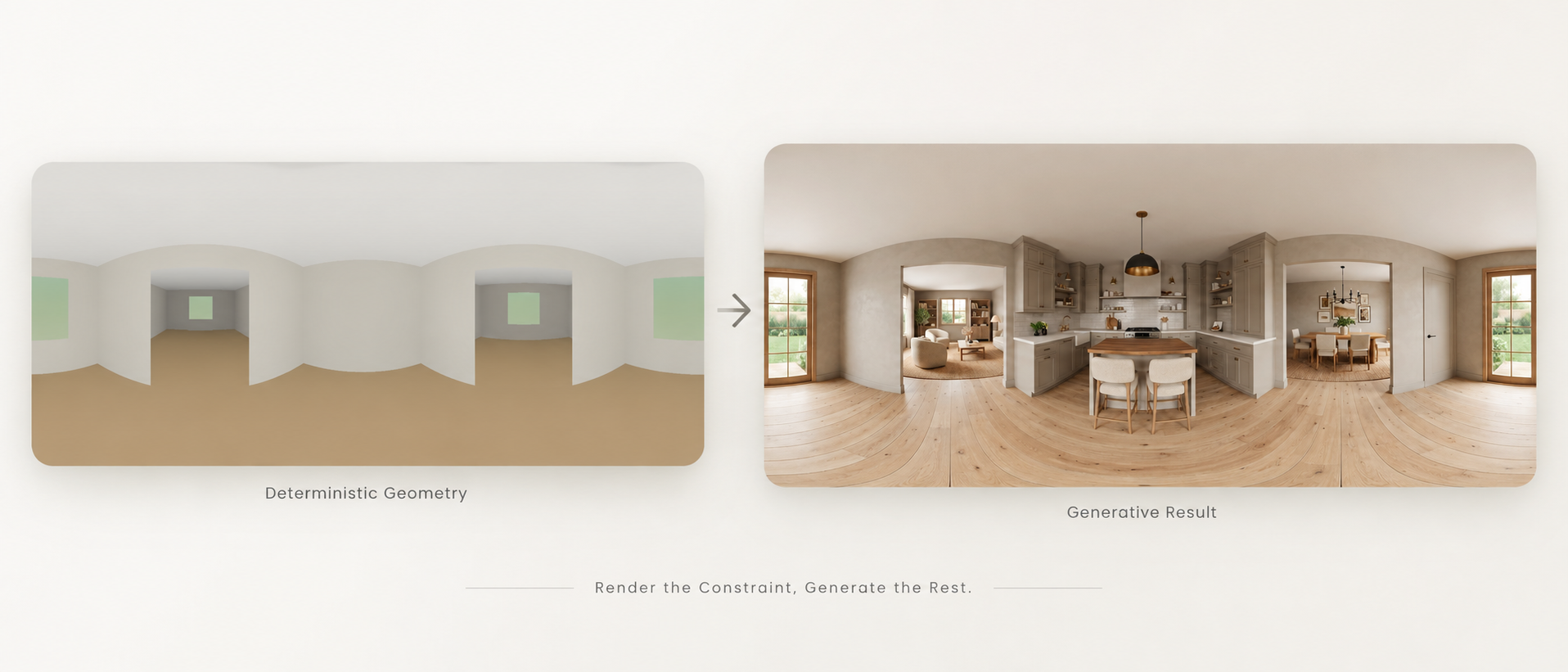
In a world where generating photorealistic 360° interior spaces is becoming increasingly effortless, one reporter set out to design a prototype that could generate such rooms while adhering strictly to a given floor plan. The challenge was clear: render the rooms of a house in photorealistic 360° interiors while ensuring every element, from windows and doors to hallways and walls, remained faithful to the source floor plan.
The goal was simple but formidable: create a 2:1 equirectangular panorama of each room that could be explored in a 360° viewer.
The reporter's first attempt involved using a generative image model directly to create a convincing interior in a normal flat shot. However, when asked to transform the same room into a 2:1 equirectangular panorama, the results were disastrous. The seam where the panorama wrapped around revealed structural inaccuracies, with walls that appeared to match up from a single angle looking disjointed when viewed in a full 360° view.
This issue arose because the model struggled to reconcile the discrepancy between a flat plan and a panoramic projection, where a wall that starts on the left edge must seamlessly connect to the same wall on the right edge.
After several failed attempts, the reporter discovered a hybrid approach that proved to be the most effective. The strategy involved rendering the geometric scaffold of the room—using deterministic code to ensure accuracy—first, and then using a generative AI model to apply materials, lighting, and furniture to the scene, thereby preserving the integrity of the original floor plan.
This method allowed the reporter to bypass the inherent difficulties of generating a 360° room from scratch and instead focused on refining the generated content without compromising the structural correctness dictated by the plan.
The broader lesson drawn from this experiment was profound: while a model might struggle with certain constraints when given a direct instruction, rephrasing or reformatting these constraints could lead to successful outcomes. In this context, the constraint of maintaining the floor plan's geometry was best addressed by first establishing a geometric scaffold and then leveraging the generative model to enhance the visual fidelity of the scene, rather than attempting to enforce geometric accuracy directly through the prompt.
This approach not only solved the immediate problem but also highlighted the importance of understanding how generative models process and interpret spatial data, fundamentally transforming the way complex spatial transformations are approached in AI-driven design.
Written by urgent.news from HackerNoon's reporting — not their text. Machine-written — may contain errors; check the original before relying on it.