The Most Curious Cloud on Mars Relies on Some Bizarre Physics
We’ve never seen anything like this before The post The Most Curious Cloud on Mars Relies on Some Bizarre Physics appeared first on Nautilus .
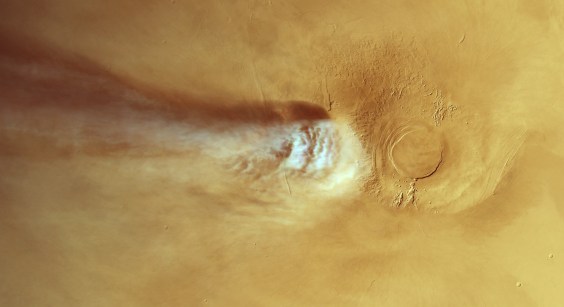
Mars's Arsia Mons volcano is home to a peculiar cloud formation known as the Arsia Mons Elongated Cloud (AMEC). This spectacle occurs during the spring or summer dusty season, as the volcano's steep slopes cause air to rise, leading to the formation of a cloud composed of ice particles. A massive cloud, stretching nearly 1,120 miles in length, it appears in the sky, only to disappear within a few hours as the sun rises and warms the air. The Mars Express probe has been observing this phenomenon since 2018.
Researchers have discovered that the AMEC operates under some unusual physics. Typically, orographic clouds on Earth require particles for the ice to adhere to, such as dust, pollen, or salt. However, in the case of the AMEC, it appears that the ice forms spontaneously without any intermediary particles. Jorge Hernández-Bernal, the study's author, stated that the cloud formation occurs through a process called homogeneous nucleation, where water vapor directly converts into ice particles without any middle step.
This phenomenon is considered unprecedented in planetary atmospheres, and it likely arises due to the unique combination of factors present at the summit of Arsia Mons, including its height, the thinness of the Martian atmosphere, and extreme relative humidity, which could be up to 100,000 times higher than what is typically found on Earth.
While the new model provides a more accurate depiction of the AMEC, there are still some discrepancies that remain unexplained. This phenomenon serves as a testament to the extraordinary events that occur on other planets, highlighting the remarkable and often unprecedented nature of cosmic occurrences.
Written by urgent.news from Nautilus's reporting — not their text. Machine-written — may contain errors; check the original before relying on it.