The Death of Choosing
How much of your thinking is AI doing for you? More than you’d like to admit. The scary part about AI isn't that it might replace jobs. It's that it might replace choice. We live in a world where we are under the constant influence of the algorithm. It keeps track of what we buy, listen to and increasingly, what we think. The convenience is incredible. But it comes at a high cost. 𝙏𝙝𝙚…
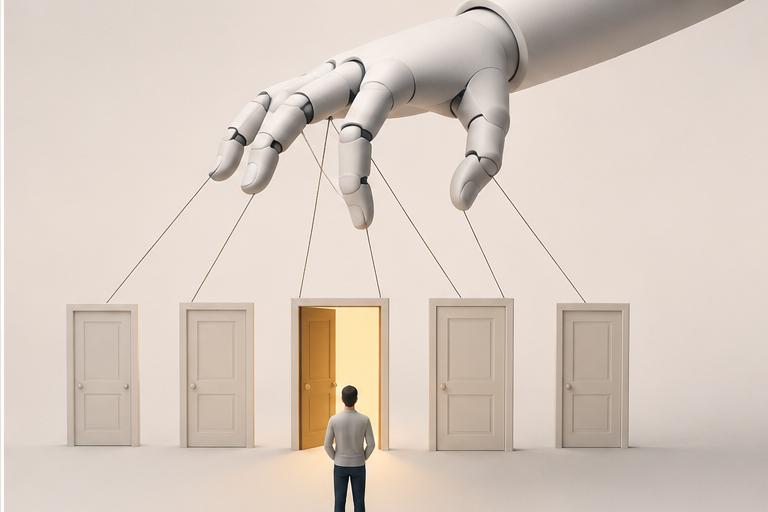
In a world increasingly dominated by artificial intelligence, the question arises: are we still choosing for ourselves, or are we merely following the paths laid out by AI? The prevalence of AI in our daily lives has led many to rely more heavily on its suggestions than ever before. From entertainment choices to career paths and life decisions, AI has become an influential force in shaping our paths.
No longer do we meticulously weigh the pros and cons of a situation, consult others, and arrive at a decision that feels authentically our own. Instead, the mere act of typing a prompt into ChatGPT often suffices. At the nexus of the prompt and answer lies a subtle surrender of our own thinking to AI.
The impact of AI isn't confined to just personal choices. Students now lean towards academic paths that are trending online. When faced with life-altering decisions, people turn to AI for advice. A single, late-night prompt can provide a detailed roadmap that appears so tempting that it's easy to follow without question.
Of course, AI offers undeniable convenience. It saves time, reduces effort, and simplifies decision-making. However, this ease comes with a significant trade-off. It leads us to live within a narrow, algorithmically curated bubble. The convenience does not erase our choices; it makes choosing so effortless that we forget we ever had options.
Real choices, once built through discussions with elders, disagreements with friends, and debates that challenged our beliefs, now seem effortless to AI. The process that once forged an authentic opinion is no longer necessary. We now run our thoughts through AI not to learn new things, but to receive external validation of our already formed beliefs.
The convenience of AI has turned it into a substitute for self-confidence in our own judgments. We research, read, and think, but we inevitably run our thoughts through AI to confirm our correctness. What began as a tool for guidance has quietly evolved into a replacement for our own judgement.
Today, we receive answers without questioning the process, calling it an informed decision. Yet, an opinion never questioned is rarely truly our own – it's borrowed. We are all, in a sense, victims of AI. It's true that if you aren't using AI, you're walking backwards in decision-making. But AI was designed to assist our thinking, not replace it.
One of the most pressing threats I see is not AI taking away our jobs, but the diminishing of our willingness to choose. As every answer is handed to us, every decision is optimized, and every doubt is cleared instantly, we risk losing the most defining human characteristic: the ability to think, question, and decide for ourselves. The algorithm will always have an answer, but the question remains: does your decision still have one?
Rewritten by urgent.news; may contain errors — check the original.