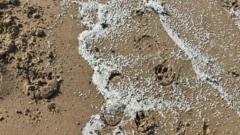
The Caspian Sea has been shrinking for decades. Now, a new island has emerged
Scientists warn that parts of the northern Caspian could face an Aral Sea-like scenario, while climate change and human water use are adding pressure on the region.
The Caspian Sea, the largest inland body of water on Earth, has been shrinking for decades due to a combination of climate change and human activity. Recently, a new island has emerged in the northern and north-eastern parts of the sea, along Kazakhstan's coast, where the sea is at its shallowest, typically ranging between three and six meters.
Volunteer and environmental activist Daniyar Akimzhanov discovered the island near Kulaly Island during a recent aerial survey. He notes that while the newly emerged island is relatively small, it is not an isolated case. In the past four to five years, he has documented several other new islands in this part of the Caspian Sea. Some of these islands stretch around one kilometer in length and 200 to 300 meters in width, and wildlife, such as wild boars and wolves, have already begun to reach the newly exposed land.
The Kazakh Research Institute of the Caspian Sea predicts that more areas of land will emerge in the future, although not all will become permanent islands. The emergence of new islands is a visible sign of the broader transformation of the Caspian Sea retreating. Its water level in the Kazakh sector has fallen from -26.82 meters in 1996 to -29.27 meters in 2025, a decline of 2.45 meters over the past three decades, or an average of around 8–9 centimeters per year.
The retreating sea is already causing significant changes in the ecosystem, particularly affecting the Caspian seal population.
Written by urgent.news from Euronews's reporting — not their text. Machine-written — may contain errors; check the original before relying on it.